
Why Japanese Taxi Culture Feels So Different to Foreign Visitors
Why Japanese Taxi Culture Feels So Different to Foreign Visitors
Published June 2026 · Updated June 2026
The taxi door opened by itself before I even touched the handle.
I see this moment almost every single day. A tourist steps toward my cab, reaches for the door, and then freezes for half a second as it swings open on its own. Some of them laugh. Some look around, half-expecting a hidden camera. One American gentleman last spring actually said, “Wait, did you do that?” — and yes, I did, with a little lever next to my seat. But to him it felt like a small piece of magic.
My name is Tayama. I’ve driven a taxi in Tokyo for eight years, and I’ve carried thousands of foreign visitors across this city — from jet-lagged families landing at Haneda at 2 a.m. to honeymooners trying to find a tiny ramen shop in a back alley of Shinjuku. Over the years I’ve learned that for many travelers, the taxi isn’t just how they get from A to B. It’s one of the first real conversations they have with Japan.
This article is my attempt to explain, from behind the wheel, why Japanese taxi culture surprises so many people, and why a simple ride in a Tokyo taxi ends up being one of the most quietly memorable parts of a trip to Japan.
Quick context: in 2026, with inbound tourism at record highs, even new tools are appearing to bridge the language gap — like apps that let visitors show a destination as a QR code for the driver to scan. The technology is changing fast, but the culture behind the wheel has stayed remarkably the same.
Why Tourists Are Surprised by Japanese Taxis
If I had to name the three things that surprise foreign visitors most, they’d be the same every time: the doors, the cleanliness, and the white gloves.
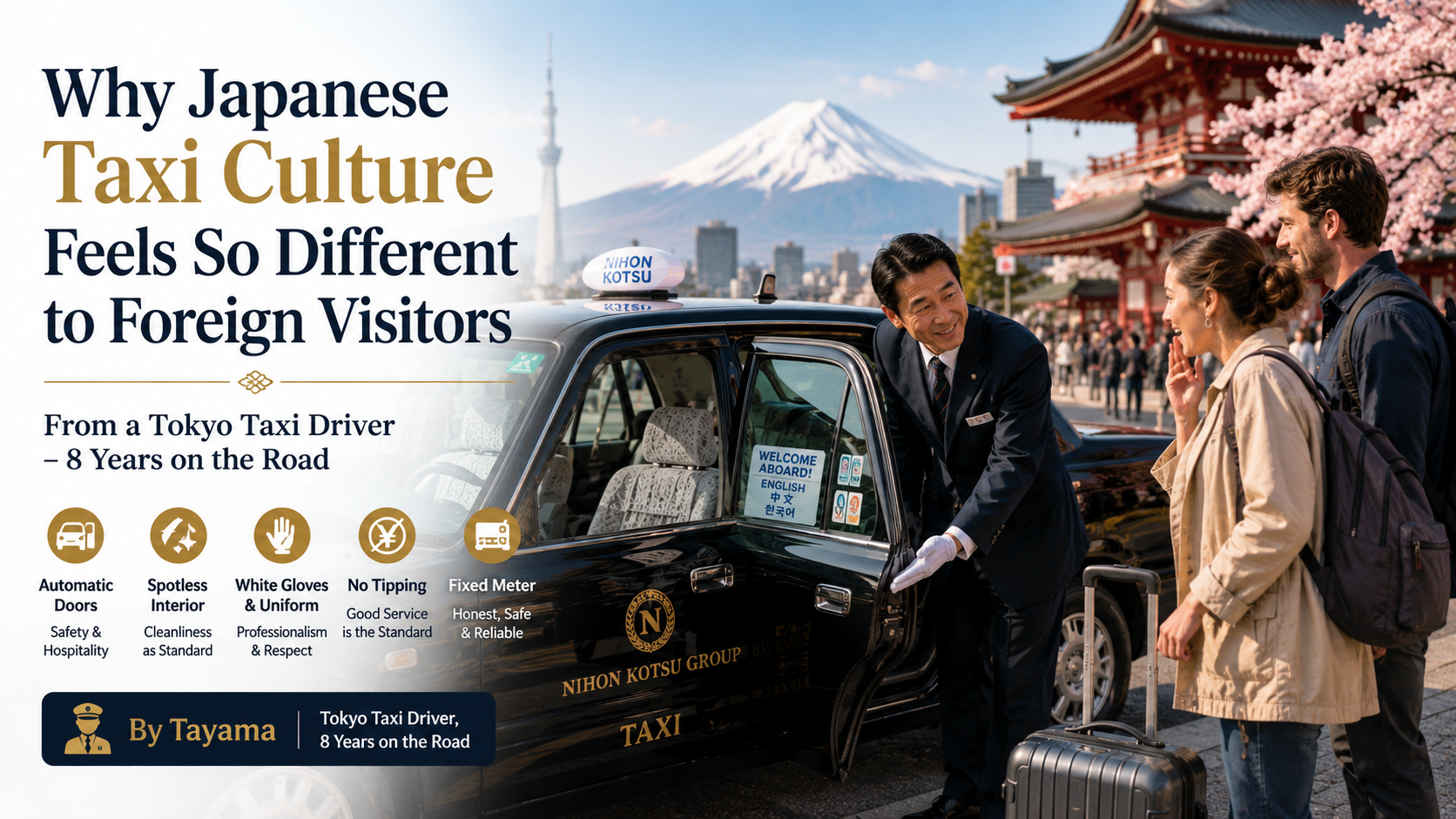
Let’s start with the doors, since that’s usually the first shock. In Japan, the rear passenger door is operated by the driver. It opens automatically when you arrive and closes once you’re settled. There’s a practical reason — it keeps the door from swinging into traffic or pedestrians — but the effect on a first-time visitor is pure delight. I’ve watched grown adults wave their hands over the handle like it’s a sensor at an airport.
Then there’s the cleanliness. People often ask me, almost suspiciously, “Why is this car so clean?” The honest answer is that it’s simply expected. Most drivers wipe down their seats and clean the interior at the start of every shift. Many cars have lace seat covers, an air freshener, and a small box of tissues. The vehicle is our workplace, but it’s also, in a sense, a guest room. You don’t invite a guest into a dirty room.
And the gloves. A lot of older drivers, myself included on formal days, wear white cotton gloves. To a tourist it can look almost like a uniform from another era. To us it’s a quiet signal: I’m taking this job seriously, and I’m taking care of you.
| Surprise | Why it happens |
|---|---|
| Automatic doors | Driver-operated for safety and hospitality |
| Spotless interior | Cleaning is a daily, expected ritual |
| White gloves & uniform | A sign of professionalism and respect |
| No tipping | Good service is simply the standard |
| Fixed, honest meter | No haggling, no surprise detours |
That last one — no tipping — confuses people the most. Visitors from the United States especially will try to round up or leave extra, and I always gently hand it back. In Japan, doing the job well isn’t something you pay a bonus for. It’s just the job. That single idea explains an enormous amount about taxi culture in Japan.
What Makes Tokyo Taxi Drivers Different
As a Tokyo taxi driver, I often see tourists surprised not just by the car, but by us — the drivers.
Becoming a taxi driver here isn’t as casual as people assume. You need a special license (a “second-class” driving license), you study local geography, and many companies put new drivers through weeks of training that covers everything from routes to manners to how to help an elderly passenger with their bags. It’s treated as a profession, not a side gig.
That training shows up in small ways that foreign visitors notice immediately. We bow slightly. We speak softly. We confirm your destination clearly before we move. If you look lost, we’ll often offer suggestions. Many of my colleagues keep a folder of maps, restaurant cards, and tourist information just in case. I keep a little laminated sheet of common phrases in English and Chinese, because I’d rather try and get it slightly wrong than leave a guest feeling stranded.
And here’s something travelers rarely expect: many of us genuinely like talking to you. After eight years, I can tell you that carrying visitors from all over the world is one of the best parts of this job. I’ve recommended late-night gyoza spots, explained why we bow, talked about sumo, and once spent a whole ride teaching a couple from Brazil how to count to ten in Japanese. By the time they got out, they could do it. That made my whole night.
Driver’s tip: If you want restaurant recommendations, just ask. Many Tokyo drivers spend twelve-hour shifts crisscrossing the city and know which small places are actually good — not the ones in every guidebook, but the ones locals quietly love.
Japanese Taxi Culture vs Uber Culture
This is the question I get more than any other from visitors: “Is Uber in Japan a thing?”
The short answer is: yes, but not the way you’re used to. For a long time, Japan’s regulations meant that ordinary people couldn’t simply sign up to drive strangers around in their private cars the way they do in many countries. Ride-hailing apps largely connect you to licensed, professional taxi drivers — like me — rather than to a neighbor with a spare seat. So even when you “order an Uber” in Tokyo, you’re often getting a regular taxi and a regular taxi driver.
That distinction matters more than it sounds. The whole experience of Uber in Japan is built on top of the existing professional taxi system, which is why the cars are clean, the drivers are trained, and the service feels consistent. You’re not gambling on a stranger’s car and mood. You’re getting the same standard every time.
| Japanese taxi | Many overseas ride-hailing services |
|---|---|
| Professional, licensed driver | Often a private individual |
| Fixed metered fare | Surge pricing varies by demand |
| No tipping expected | Tipping common or prompted |
| Hailed on the street or by app | App-only in many cities |
One more thing that delights visitors: you can still raise your hand on the street and a taxi will stop. No app, no account, no waiting for a pin to move across a map. In an age where everything requires a download, there’s something refreshing about simply lifting your arm and having a clean, safe ride pull over within seconds.
Why Taxis Feel Safe in Japan
Safety is the word I hear most from solo travelers, and especially from women traveling alone. They tell me they feel comfortable taking a taxi at night here in a way they sometimes don’t back home. I’m always glad to hear it, because that feeling is real and it’s earned.
Part of it is the drivers themselves. We’re licensed, registered, and identifiable — my name and company are displayed in the car. Part of it is the meter: the fare is calculated by the machine, the rate is regulated, and there’s no negotiating or “tourist price.” You will never get into a Tokyo taxi and be quoted a random number. What the meter says is what you pay.
And part of it is simply the broader culture. Tokyo is an extraordinarily safe city, and the taxi network reflects that. Late at night, when the trains have stopped, a taxi becomes the safest, simplest way to get back to your hotel. I’ve driven countless visitors home at 3 a.m. after a long night in Shibuya, and watching them relax into the back seat — knowing they’re in good hands — is something I take real pride in.
This is also why the lost-and-found culture astonishes people. Leave your phone, your wallet, even your passport in a Japanese taxi, and there’s a very strong chance it comes back to you. Drivers hand items in to the company or the police as a matter of course. I’ve personally returned a forgotten laptop bag, a wedding ring in a tiny box, and more umbrellas than I can count. To us it’s normal. To a visitor who lost a wallet abroad and never saw it again, it feels almost unbelievable.
If you forget something: Note the taxi company name and, if you have it, the receipt — every ride can issue one with the company details. Contact the company or the nearest police station. Recovery rates in Japan are remarkably high.
How Taxi Drivers Help Travelers Experience Japan
Here’s the part I most want visitors to understand: in Japan, a taxi driver can be a kind of accidental tour guide.
We spend our entire working lives moving through the city. We know which streets are beautiful at sunset, which shrines are quiet on a weekday morning, where to find the ramen shop with the line that’s actually worth it, and which route gives you the best first glimpse of Tokyo Tower glowing at night. None of this is in the meter. It’s just what comes out when a curious passenger starts a conversation.
For the airport run especially, a taxi is hard to beat. Arriving in a new country exhausted, with luggage, and not speaking the language is stressful. Stepping into a clean car with a calm, professional driver who handles your bags and gets you to your hotel without fuss is the gentlest possible introduction to Japan. The same is true at the end of a trip — a quiet, comfortable ride to Haneda or Narita while you watch the city slide past one last time.
The language barrier used to be the one real obstacle. But even that is fading. Translation apps, pointing at maps, and newer tools — including QR-code navigation apps designed in 2026 to let visitors simply show a driver where they want to go — mean that getting your destination across is easier than ever. As a driver, I welcome anything that helps me understand a guest faster and get them where they’re going. The goal was never to talk perfectly. The goal is to take care of you.
So my advice to any traveler is this: don’t treat the taxi as a black box that moves you across the map. Treat it as a small, moving window into how Japan thinks about service, safety, and respect. Some of my favorite memories from eight years on the road are the conversations that started with a nervous “Do you speak English?” and ended with a real connection.
Final Thoughts
People come to Japan for the temples, the food, the cherry blossoms, the neon. They rarely come for the taxis. And yet, again and again, the taxi is the thing they end up telling stories about when they get home — the door that opened by itself, the spotless seats, the driver in white gloves who returned a lost phone, the late-night ride that felt completely safe.
That’s because Japanese taxi culture isn’t really about transportation at all. It’s a small, daily expression of the same values that run through the whole country: cleanliness, care, honesty, and a quiet pride in doing things well. You can feel all of it in a ten-minute ride.
So when you plan your Tokyo travel, leave a little room in your Japan travel tips list for the simple act of taking a taxi. It might be the most underrated cultural experience of your trip.
A note from Tayama
If you visit Tokyo, don’t just use taxis as transportation. Talk to the driver. You may discover a side of Japan guidebooks never show you.