
Best Local Food in Shinjuku Recommended by Tokyo Taxi Drivers (2026 Guide)

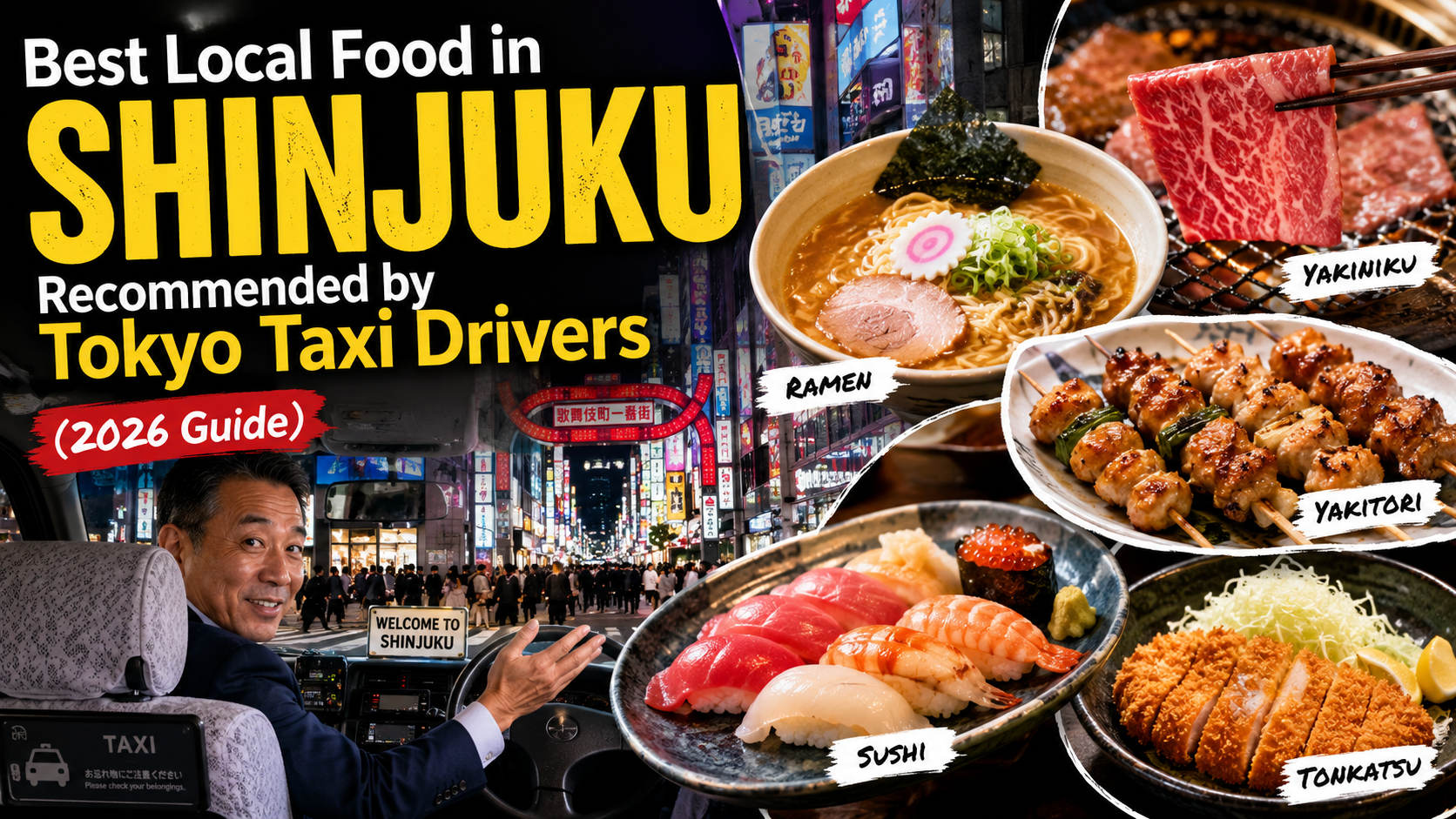
Introduction: Shinjuku Through a Taxi Driver’s Eyes
I’ve spent eight years driving a taxi in Tokyo. In that time, I’ve covered roughly 800,000 kilometers — most of them in and around Shinjuku.
I’ve waited at red lights outside ramen shops at 2 AM while the smell drifted through my window. I’ve dropped off regulars at tiny izakaya tucked into back alleys that don’t even have proper signage. I’ve watched food trends come and go — the tapioca boom, the maritozzo wave, the whole viral social media restaurant cycle — while the same unpretentious noodle counter my colleague Yamashita-san has been eating at since 1998 keeps packing in the regulars every single night.
Shinjuku is one of the most food-dense neighborhoods on the planet. Within a ten-minute walk of Shinjuku Station’s east exit, you can eat your way through ramen, sushi, yakitori, tonkatsu, Korean BBQ, Nepalese curry, craft beer, Japanese whisky highballs, and handmade soba — sometimes for under ¥1,000, sometimes for ¥30,000. The range is genuinely staggering.
The problem is that most tourist guides will send you straight to the obvious places — the Michelin-listed spots, the places with English menus posted outside and staff who speak rehearsed phrases. Those places are fine. But they’re not where locals eat.
This guide is different. It’s written from the perspective of someone who has spent thousands of hours in Shinjuku not as a tourist, but as a working professional who needs to eat quickly, eat well, and eat on a budget while keeping a schedule. These are the restaurants and eating habits of Tokyo taxi drivers — and I think they’ll serve you a lot better than the average travel blog.
Let’s eat.
Why Tokyo Taxi Drivers Know the Best Food Spots
There’s a reason I trust food recommendations from taxi drivers over food critics, travel influencers, and review platforms. It comes down to how we discover restaurants — and how we don’t.
We Eat at Weird Hours
Most of us work split shifts or night shifts. I’m often finishing a run at 1 AM, starving, needing something hot and real — not convenience store rice balls. Over time, you develop a personal map of the city based entirely on where you can eat well outside of normal hours. My mental map of Shinjuku after midnight is more detailed than any food app I’ve ever used.
We Listen to Passengers
In eight years of taxi driving, I’ve had thousands of conversations about food. Drunk salarymen telling me about the best yakitori they just had. Chefs heading home after a double shift recommending their colleagues’ restaurants. Regular passengers who turn me on to a new spot they discovered. Taxi drivers in Tokyo are essentially walking, constantly-updating food databases built from thousands of micro-conversations.
We Know the Side Streets
Tourist-facing restaurants cluster near station exits and main boulevards because foot traffic drives their business. Taxi drivers cut through the side streets dozens of times a night. We see the small places — the eight-seat counter ramen shop, the standing izakaya where the owner pours generous measures, the Korean home cooking place in a building with no elevator. We develop a feel for which ones are serious.
We Can’t Afford Tourist Markup
A Tokyo taxi driver’s take-home pay doesn’t support eating at inflated prices. We eat at places where ¥1,200 gets you a genuinely good meal because the owner is cooking food they’re proud of, not food styled for Instagram. That budget pressure filters out mediocrity fast.
So when I tell you about a restaurant in Shinjuku, it’s not because it was sent to me by a PR agency or because it ranks on a travel app. It’s because I, or someone I work alongside, has actually eaten there — usually more than once.
Best Areas Around Shinjuku Station for Food
Shinjuku Station is the world’s busiest railway station — about 3.5 million people pass through it every day. The eating landscape around it is organized loosely by district, and each has a completely different feel.
East Exit
Kabukicho & Shinjuku-sanchome
The most accessible side with the widest variety. The main Kabukicho boulevard draws crowds, but the real action is one or two blocks off it. Shinjuku-sanchome (7 min walk / 1 subway stop) has a proper neighborhood feel with smaller, independently owned restaurants.
West Exit — 1 min walk
Omoide Yokocho (Memory Lane)
A narrow 100-meter alley packed with tiny post-war yakitori stalls. Charcoal smoke, cold beer, chicken skewers. Seats 6–10 people per stall. Yes, tourists know about it — but it’s still genuinely good.
South Exit
Takashimaya Times Square & Yoyogi Side
More commercial, anchored by the Takashimaya department store. Upper-floor restaurant floors offer excellent mid-range dining. The streets between Shinjuku and Yoyogi are strong for budget teishoku lunch sets on weekdays.
North Exit — 5 min walk
Hyakunincho — The International Quarter
Few tourists find this area. Pakistani, Indian, Bangladeshi, and Nepali restaurants mixed in with old Tokyo shotengai architecture. Halal food is genuinely easy to find here — one of the most reliable pockets in Tokyo for it.
Recommended Food Categories — What to Eat in Shinjuku
Rather than list individual restaurants (most change faster than any guide can keep up with), I want to help you understand what to order and where to look. These are the categories I come back to personally.
Ramen — The After-Shift Essential
Shinjuku ramen isn’t a single thing. Within a five-minute walk of the station you can find tonkotsu (pork bone broth, rich and cloudy), shoyu (soy-based, clear and complex), shio (salt-based, delicate), miso, and tsukemen (dipping-style noodles). My personal preference after a night shift is mid-weight shoyu — not the heavy tonkotsu that sits in your stomach while you’re still driving.
Look for a counter with a ticket vending machine at the entrance, small seating capacity, and noodles made in-house. The small side streets north of Kabukicho have half a dozen excellent counters that rarely show up in tourist guides.
→ Deep dive: Best Ramen in Shinjuku for Foreign Tourists
Izakaya — How Japanese People Actually Drink
An izakaya is not a pub. The closest Western equivalent might be a Spanish tapas restaurant with unlimited beer — but even that doesn’t capture it. Groups order round after round of shared dishes alongside drinks, staying two or three hours without any pressure to move on.
The food is genuinely good — not bar snacks. Expect grilled items (yakitori, kushiyaki), fried items (karaage, agedashi tofu), sashimi, sesame-dressed salads, and a rotating seasonal menu. The best izakaya for visitors are in the back streets east of Kabukicho and around Shinjuku-sanchome. Look for a proper handwritten menu — it usually means the dishes change with the season, which is a good sign.
→ Full breakdown: Best Izakaya in Shinjuku — Taxi Driver Picks
Sushi — Counters, Standing Bars, and Department Stores
Shinjuku has excellent sushi at every price point. Department store basement floors (Takashimaya, Isetan) for a splurge; Shinjuku-sanchome counter-style restaurants for mid-range; kaiten-zushi (conveyor belt) chains and standing sushi bars for budget options at ¥150–¥300 per plate. Don’t dismiss the standing bars — the fish quality is often better than you’d expect because turnover is high and stock arrives fresh constantly.
→ Full recommendations: Best Conveyor Belt Sushi in Shinjuku — What Locals Actually Order
Tonkatsu — The Underrated Comfort Food
Breaded, deep-fried pork cutlet — thick, well-marbled loin or fillet, panko-crusted, fried to a perfect golden crust. Served with shredded cabbage, miso soup, and rice. Eaten with a thick, slightly sweet tonkatsu sauce. This is not a health food. It is, however, extremely satisfying at ¥1,200–¥2,000 for a proper set. Look for restaurants with a dedicated frying station visible from the counter — watching the cutlet go into the oil is part of the experience.
Yakiniku — Japanese BBQ, Done Right
Japanese-style BBQ where you grill your own thin-cut beef, pork, and offal over a charcoal or gas grill built into the table. Interactive, social, and deeply satisfying. Shinjuku has yakiniku ranging from all-you-can-eat chains (tabehoudai, usually ¥3,000–¥4,500 for a set time) to high-end Wagyu restaurants where a single piece of A5 beef dissolves in your mouth.
→ Full guide: Best Yakiniku in Shinjuku — From Budget Tabehoudai to Premium Wagyu
Soba and Udon — The Noodles Most Tourists Overlook
Ramen gets all the attention from foreign tourists, but soba (buckwheat noodles) and udon (thick wheat noodles) are equally embedded in Japanese food culture — and arguably more representative of everyday Tokyo eating. You’ll find soba shops in the Shinjuku area that have operated for over a hundred years. Udon in Kanto comes in a darker, stronger soy-forward broth — warming and deeply savory. Standing udon shops near Shinjuku Station are popular with commuters for breakfast and lunch.
→ Dedicated guides: Soba and Udon in Shinjuku The Noodles Most Tourists Overlook
Steak — Western-Style Beef Done the Japanese Way
Japanese steakhouses are their own distinct category. Whether it’s teppanyaki (chef cooks on an iron griddle in front of you), a standing steak bar, or a more formal steakhouse, the Japanese approach to beef — particularly Wagyu — is unlike anything you’ll encounter elsewhere. The marbling, the cut thickness, the sauces (often ponzu-based or yuzu-pepper seasoned), and the service style are uniquely Japanese. A serious steak dinner here is worth the splurge at least once.
→ Full guide: Best Steak Restaurants in Shinjuku — From Teppanyaki to Wagyu Counters
Japanese Curry — The Comfort Food Nobody Expects to Love
Japanese curry (kare raisu) is not Indian curry. It developed through a fascinating historical path — introduced via the British Royal Navy during the Meiji period — and evolved into something distinctly Japanese: sweeter, thicker, milder, and deeply warming. Shinjuku has both specialist curry restaurants with extraordinarily complex spice blends and casual cafeteria-style curry houses serving massive portions to office workers.
→ Full recommendations: Best Japanese Curry in Shinjuku — What Makes It Different
Street Food and Snacks
Shinjuku isn’t as strong on street food as Asakusa or the festival circuit, but there are good opportunities for casual eating on the move. The underground shopping streets beneath Shinjuku Station have counters selling croquettes, taiyaki (fish-shaped cakes filled with red bean paste or custard), and freshly made onigiri. During weekends, temporary market stalls sometimes set up around the east and south exits.
→ Broader look: Best Japanese Street Food in Shinjuku — Casual Eating Between Sights
Local Etiquette: How to Eat Like a Tokyo Local
Japanese restaurant etiquette isn’t strict or formal in most places — but a few habits will make your experience smoother and signal to staff that you’re a respectful guest.
🧻 Oshibori — The Hot Towel
Most restaurants bring a small rolled towel when you sit. It’s for your hands. Use it, fold it roughly, and set it aside. Not a face napkin.
🔔 Calling Staff
Press the call button on the table if there is one. Otherwise, brief eye contact and a quiet “sumimasen” (excuse me). No waving, no shouting.
🍜 Slurping
Slurping ramen, soba, and udon is culturally normal in Japan. You don’t need to actively slurp, but nobody will look twice if you do.
💴 Paying the Bill
In most restaurants, take your bill to the register near the exit when ready. You don’t pay at the table. “O-kaikei onegaishimasu” means “check, please.”
🚫 No Tipping
Do not tip. Staff may literally chase you down the street to return money they think you forgot. Excellent service here is simply the standard.
👟 Shoes at Tatami Restaurants
Some traditional izakaya with tatami floors require removing shoes. There’s always a clear visual cue — a step up, a row of slippers. When in doubt, watch other customers.
🪑 Solo Dining Is Totally Normal
Japan is one of the most solo-diner-friendly countries in the world. Counter seating at ramen shops, sushi bars, and many izakaya is designed for single diners. Nobody will look at you strangely. Eating solo at a counter in a good ramen shop is one of the most genuinely Tokyo experiences you can have.
Best Late-Night Food in Shinjuku (After Midnight)
This section exists because of my job. After a long night shift, eating a hot, real meal at 1 AM or 2 AM is a practical necessity — and Shinjuku is one of the few neighborhoods in Tokyo where this is genuinely possible without resorting to convenience store food.
🚖 Taxi Driver’s 1 AM Rule
If there are lights on, someone is actively ordering food, and the place has been there for at least a few years — it’s worth trying. Places that survive the Shinjuku late-night dining competition without a tourist base are surviving on quality alone.
The Kabukicho Back Streets (After 11 PM)
The streets immediately behind the Kabukicho entertainment district have the densest concentration of late-night options in Shinjuku. From about 11 PM onward:
- Ramen counters — most open until 3–4 AM, some 24 hours. A queue at midnight in Kabukicho is a reliable quality signal.
- Gyukatsu (beef cutlet) shops — similar to tonkatsu but with beef, often with a small personal grill. Several open until 2–3 AM.
- Yakitori standing bars — some small grilled skewer counters specifically target the after-midnight crowd.
- Convenience stores with eat-in space — 7-Eleven in Japan is genuinely a food stop. Hot dishes, excellent onigiri, noodles. 24 hours.
Omoide Yokocho — Last Orders Around Midnight
Memory Lane tends to wind down between 11 PM and midnight, though some stalls push to 1 AM on weekends. Aim to get there by 9–10 PM for the fullest selection.
Shinjuku-sanchome Late-Night Scene
About 7 minutes on foot from Shinjuku Station east exit (or one stop on the Marunouchi/Fukutoshin line), this area has a late-night izakaya and bar scene running until 2–3 AM. Also home to Tokyo’s LGBTQ+ entertainment district (Ni-chome), making the atmosphere notably welcoming and international.
Best Budget-Friendly Food in Shinjuku (Under ¥1,500)
You can eat very well in Shinjuku without spending much money — and in many cases, the cheapest meals are the most authentically local.
Standing Soba and Udon Shops (¥400–¥700)
The fastest and cheapest hot meal in Shinjuku. Often found inside or directly outside train stations — the Shinjuku underground complex has several. Order at a machine with photo buttons, wait two minutes, stand at the counter and eat. This is what commuters and taxi drivers eat when they have fifteen minutes.
Gyudon Chains — Fast, Filling, Honest Food (¥450–¥800)
Yoshinoya, Sukiya, and Matsuya all have multiple locations within walking distance of Shinjuku Station. A gyudon is thinly sliced simmered beef over steamed rice, topped with pickled ginger. Open 24 hours. No language barrier. I’ve eaten gyudon at Yoshinoya after a twelve-hour night shift more times than I can count — it is exactly what you need at that moment.
Teishoku Lunch Sets (¥850–¥1,200)
A set meal — grilled fish, chicken, or pork with rice, miso soup, and two or three side dishes. Best between 11:30 AM and 2 PM. The streets south of Shinjuku Station toward Yoyogi have several solid teishoku restaurants used primarily by local workers, with no interest in tourist traffic.
Convenience Stores — The Secret Weapon
I say this without irony: 7-Eleven, Lawson, and FamilyMart in Japan have better food than most fast food restaurants in other countries. Onigiri made fresh daily. Sandwiches that are better than they have any right to be. Hot cases with karaage, steamed buns, croquettes for ¥150–¥250 per item. A proper convenience store haul can feed you well for under ¥700.
Quick Budget Reference
Frequently Asked Questions — Eating in Shinjuku
What is the best food to eat in Shinjuku?
Shinjuku is one of Tokyo’s most food-dense neighborhoods, so the honest answer is: almost everything is good here. The dishes locals return to again and again are ramen, izakaya yakitori (grilled skewers), tonkatsu, and kaisendon (seafood rice bowls). The east side near Kabukicho and Omoide Yokocho on the west side offer two completely different eating experiences. East is newer, trendier, and more varied; west is old-school, smoky, and deeply local. For a first visit, start at Omoide Yokocho for atmosphere, then explore the east side streets for a proper sit-down meal.
Where do Tokyo taxi drivers eat in Shinjuku?
We tend to eat at places that are fast, filling, affordable, and open late — because our schedules don’t match normal dining hours. The streets behind Kabukicho have small ramen counters, standing sushi bars, and curry shops open past 2 AM. Most taxi drivers also have a favorite teishoku lunch spot south of Shinjuku Station. These are working-person restaurants with no English signage and no tourist markup — which is exactly why the food is usually excellent and portions are generous.
Are there late-night restaurants in Shinjuku open past midnight?
Yes — Shinjuku has more late-night dining options than almost any neighborhood in Tokyo. Kabukicho has restaurants open until 3–4 AM or 24 hours. For truly late-night eating, head to the streets between Kabukicho and Shinjuku-sanchome station. Gyukatsu shops, tonkotsu ramen counters, and several izakaya chains are reliably open at 2 AM. As a taxi driver working night shifts, I’ve eaten proper hot meals at 3 AM here — it’s one of the few parts of Tokyo where that’s genuinely possible.
Are there halal-friendly restaurants in Shinjuku?
Yes, Shinjuku has become noticeably more halal-friendly in recent years. The area around Shinjuku-sanchome has several halal-certified restaurants serving Japanese-style curry, shawarma, and halal ramen. Hyakunincho (a short walk from Shinjuku Station’s north exit) is Tokyo’s most internationally diverse neighborhood with multiple halal restaurants. Always look for the official halal certification displayed at the entrance — “pork-free” and “halal” are not always the same thing in Japan.
Are English menus available at restaurants in Shinjuku?
It depends on the restaurant. Chain restaurants and most ramen shops have English or photo menus. Smaller mom-and-pop shops and old-school teishoku places may have Japanese-only menus. My advice: don’t let the language barrier stop you. Most staff will try to help, and pointing at neighboring diners’ food or using a translation app photo feature works perfectly. The restaurants without English menus are often the best ones.
Is tipping expected at restaurants in Tokyo?
Absolutely not. Tipping is not part of Japanese culture — staff may chase you down the street to return money they think you forgot. The price on the menu is the price you pay, plus consumption tax (currently 10%). High-end restaurants sometimes add a stated service charge of 10–15%. For casual restaurants, ramen shops, and izakaya, you simply pay the stated price and that’s it. Excellent service in Japan is simply expected as standard.
How do I avoid tourist traps when eating in Shinjuku?
The most important rule: walk one or two blocks away from any major landmark or station exit before choosing a restaurant. Places immediately outside the east exit and along Kabukicho’s main boulevard tend to price for tourists. Real neighborhood spots are on the side streets. Also: if staff are standing outside aggressively inviting you in, that’s usually not somewhere locals choose on their own. Real spots don’t need to recruit customers from the sidewalk.
What is a realistic food budget per meal in Shinjuku?
A filling ramen typically costs ¥900–¥1,400. A full izakaya dinner with drinks runs ¥2,500–¥4,000 per person. A teishoku set lunch is often ¥850–¥1,200. For most visitors, budgeting ¥1,500–¥2,500 per casual meal and ¥4,000–¥8,000 for a proper dinner with drinks is realistic. High-end kaiseki or teppanyaki can reach ¥15,000–¥30,000+ per person. Convenience store meals are genuinely good at ¥400–¥700.
Are there vegetarian-friendly restaurants in Shinjuku?
This is harder than halal in Tokyo. Japanese cooking traditionally uses dashi (fish-based stock) as a base for many dishes, so true vegetarian options require navigation. Shinjuku-sanchome has a growing number of dedicated vegetarian and vegan restaurants. Indian and South Asian restaurants in Hyakunincho naturally offer strong vegetarian menus. Tofu dishes, edamame, vegetable tempura, and zaru soba are usually safe bets at general restaurants. I recommend downloading the HappyCow app before your trip.
Is it easy to get a taxi in Shinjuku at night?
Yes and no. Taxis are plentiful in Shinjuku, but on Friday and Saturday nights between 11 PM and 2 AM, demand spikes when the last trains leave. Finding an available taxi on the street during those windows can take 20–30 minutes. Designated taxi stands near main exits of Shinjuku Station are most reliable. Using a taxi app (GO, S.RIDE, or Uber) is strongly recommended for late-night travel. Starting fares in Tokyo are currently ¥500 for the first approximately 1.1km.
Final Thoughts from the Driver’s Seat
After the busiest late-night hours finally pass in Shinjuku, Tokyo taxi drivers can finally slow down for a moment and sit down for a proper meal. Around 2 or 3 in the morning, after the last trains have disappeared and the neon glow of Kabukicho begins to fade slightly, that quiet late-night meal becomes a small way to reset before returning to the road again.
That’s why taxi drivers know where to find food that is truly satisfying — not the flashy tourist restaurants near the station exits, but the small local places hidden in Shinjuku’s side streets. Tiny ramen counters with steamed-up windows, standing soba shops open all night, old izakaya where workers and drivers gather after long shifts.
Shinjuku is unique because the city never completely sleeps. Even deep into the night, you can still find delicious gyudon shops, ramen restaurants, and comforting local food served quickly, affordably, and with the kind of consistency locals quietly depend on every day.
For many Tokyo taxi drivers, these places are more than just restaurants. They are part of our nightly routine, part of the real rhythm of Shinjuku, and part of what makes this area one of the most unforgettable food neighborhoods in Tokyo.
I’ll be adding more detailed guides to specific food categories linked throughout this article. Each one will go deeper into what to order, where specifically to look, and what to avoid. This is an ongoing project — the same way driving a taxi in Tokyo is an ongoing education.
Thanks for reading. If you ever find yourself in the back of a Tokyo taxi and the driver mentions a good late-night ramen spot — listen to them. We’ve done the research.