
Tayama's Personal Top 3 of Shinjuku’s izakaya

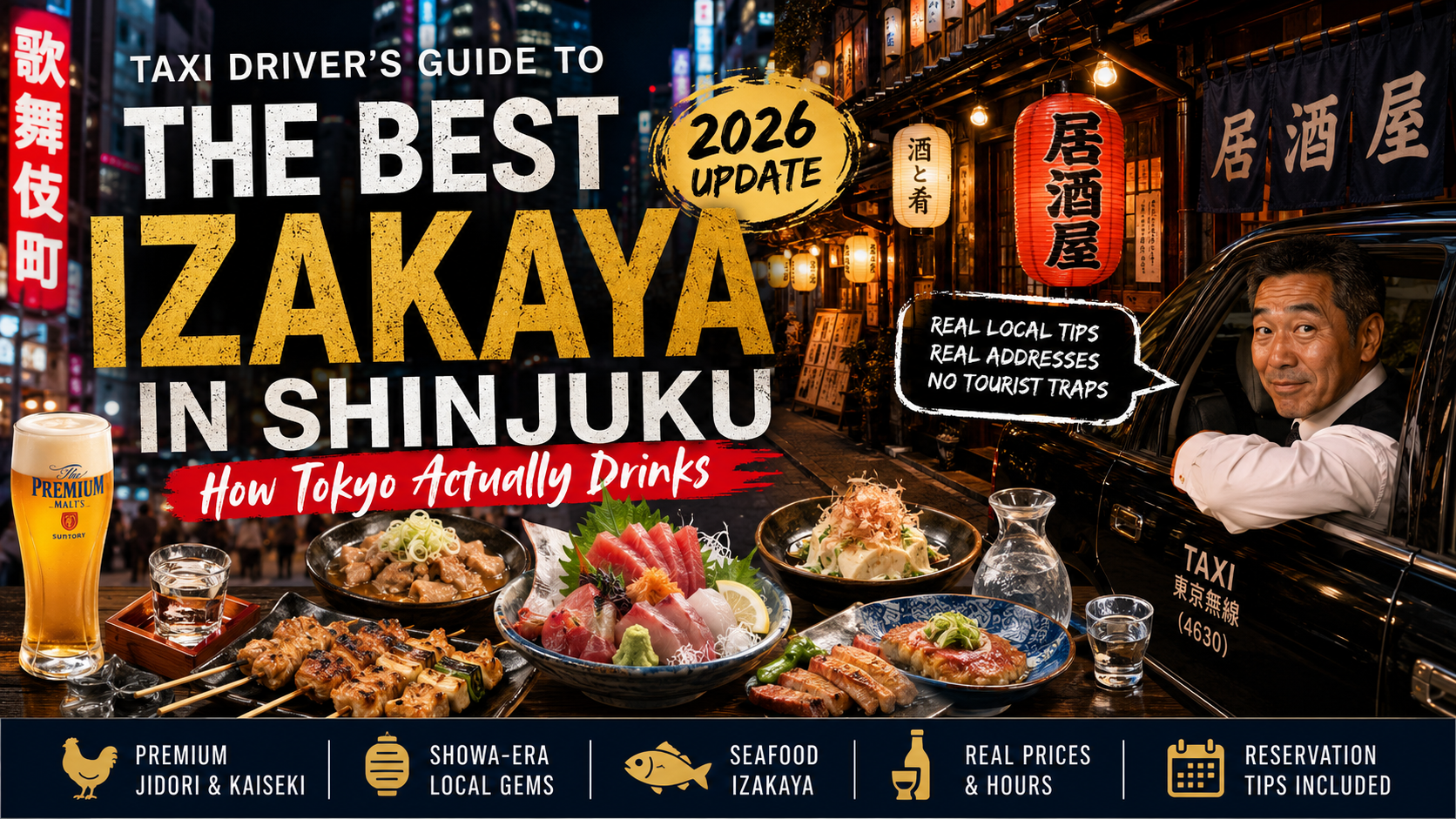
📋 What’s in this guide
- 10 Shinjuku izakaya across four tiers — from refined private-room dining to old-school local drinking dens
- What an izakaya actually is, and how Japanese people drink and eat differently from a Western bar
- Real details for every shop: address, hours, access, budget, reservation difficulty, and English friendliness
- Tayama’s order-this picks for each spot — the dish a taxi driver would point you toward
- Etiquette, ordering rhythm, and how to avoid tourist-priced traps near the station
I’m Tayama — 30 years old, eight years driving a taxi in Tokyo. More of my passengers spill out of Shinjuku izakaya than almost anywhere else in the city: salarymen three rounds deep, couples winding down a date, groups of regulars closing out a long week. Over the years I’ve built a clear sense of which of these places are worth your evening and which are just collecting station foot traffic. This guide pulls together the izakaya I’d actually send a passenger to — sorted by occasion, with honest notes on what to order and what each one costs.
An izakaya is the heart of how Tokyo eats and drinks together. It’s not a bar where you stand and sip, and it’s not a restaurant where you order one plate and leave. It’s a place to settle in for a few hours, order in waves, share everything, and let the night unfold. Shinjuku has more of them, at more price points, than anywhere else in Tokyo — and the range below runs from a 15,000-yen sukiya-style kaiseki house to a smoky Showa-era counter where 3,500 yen covers a very good evening.
🍶 Izakaya Basics — What to Know Before You Go
How it works: You’re seated at a table, counter, or private room. The first thing to do is order drinks for the whole table — beer (nama biru) is the default opening round. A small charged appetizer (otoshi, around 300–500 yen) usually arrives unrequested; this is normal and acts as a seating/cover charge, not a scam.
How to order: In waves, not all at once. Start cold or raw — sashimi, edamame, a sesame-dressed salad. Move to grilled skewers (yakitori, kushiyaki) and fried items (karaage). Then a hot main or hot-pot dish. Close with a rice or noodle dish (shime). Ordering a couple of dishes at a time keeps everything arriving fresh.
Reservations: Private rooms and weekend evenings need booking — use Tabelog or the shop’s site. Most casual spots take walk-ins on weeknights but fill up by 7 PM. Year-end (Nov–Dec) party season books out weeks ahead.
Paying: No tipping, ever. Take your bill to the register by the exit. “O-kaikei onegaishimasu” means “check, please.”
All 10 Izakaya at a Glance
| Shop | Area | Budget/Person | Style | Reservation |
|---|---|---|---|---|
| Kurumaya Bekkan | Shinjuku East | ¥15,000–¥25,000 | Sukiya kaiseki / teppanyaki Wagyu | Recommended |
| Imaiya Honten | Shinjuku-sanchome | ¥6,000–¥8,000 | Hinai-jidori chicken / private rooms | Recommended |
| Okaka | Kabukicho | ¥5,000–¥7,000 | Dashi-shabu / bonito specialist | Recommended |
| Aen Isetan Kaikan | Shinjuku-sanchome | ¥4,500–¥6,000 | Healthy washoku / Sakurayama pork | Moderate |
| Bo’s (房’s) | Shinjuku East | ¥5,000–¥7,000 | Wine-cellar bistro izakaya | Moderate |
| 23-Banchi | Shinjuku East | ¥4,500–¥6,000 | Hokkaido seafood / private rooms | Moderate |
| Sakuramichi | Nishi-Shinjuku | ¥4,000–¥5,500 | Jidori chicken / private rooms | Moderate |
| Choemon | Nishi-Shinjuku | ¥4,000–¥5,500 | Charcoal yakitori / hidden gem | Moderate |
| New Uo-Baka Santaro | Nishi-Shinjuku | ¥4,000–¥5,500 | Wholesale-direct seafood pub | Easy–Moderate |
| Omiya | Nishi-Shinjuku | ¥3,000–¥4,000 | Showa-era local drinking den | Easy |
The Formal Occasion — Kaiseki & Refined Dining
For the night that has to be perfect — entertaining, anniversaries, impressing a guest
Shinjuku East · The Prestige Choice
Kurumaya Bekkan
車屋 別館(くるまやべっかん)
If you have one evening in Shinjuku that absolutely cannot go wrong — a formal dinner, a family milestone, a guest you need to impress — this is the name that comes up first among drivers who know the area. Step inside and the sukiya-style architecture makes you forget you’re in the dead center of Shinjuku: a hushed, dignified, purely traditional Japanese space. The kaiseki here is the real thing, from the way the dashi is drawn to the beauty of the plating, with the kind of orthodox craftsmanship that quietly satisfies guests of any age.
The teppanyaki is the showpiece — selected Kuroge Wagyu and seafood grilled in front of you, enjoyed through sound and aroma as much as taste. Kimono-clad staff provide attentive, genuinely refined service. The lunch hour hides a real bargain: the famous katsu-ju (pork cutlet over rice) and seasonal set meals are offered at far gentler prices than dinner, letting you taste an old establishment’s cooking without the full commitment.
🎯 Must Order
- Teppanyaki Kuroge Wagyu — the centerpiece, grilled tableside
- Seasonal kaiseki course — the proper way to experience the kitchen at dinner
- Katsu-ju (lunch) — the old-establishment bargain, ~¥2,000–¥4,000
| Address | 3-21-1 Shinjuku, Shinjuku-ku, Tokyo |
|---|---|
| Access | ~2 min from Shinjuku Station East Exit (Alta side) · ~2 min from Seibu-Shinjuku Station |
| Hours | Lunch 11:30–16:00 · Dinner 17:00–22:30 · Closed Jan 1 |
| Budget | Lunch ¥2,000–¥6,000 · Dinner ¥15,000–¥25,000 per person |
| Rooms | Counter, tables, tatami zashiki, and Western-style private rooms |
| Reservation | Recommended, especially for private rooms and dinner |
Tayama’s take: This is the address I give when a passenger says they’re hosting someone important and can’t afford a mistake. It has a kind of timeless dignity that doesn’t chase trends — the sort of place where you can bring a superior or a future in-law and feel one hundred percent safe. If the budget is a stretch, come for the lunch set; the same kitchen, a fraction of the price.
Refined Izakaya — Specialists Worth Booking
A clear signature dish, private-room comfort, the right call for a date or a quieter celebration
Shinjuku-sanchome · Premium Jidori
Imaiya Honten
新宿 今井屋本店
Imaiya specializes in Hinai-jidori — one of Japan’s three great heritage chicken breeds, from Akita — and the difference shows the moment you bite into a skewer. The cuts are large and grilled over charcoal by experienced hands: skin crackling and fragrant on the outside, startlingly juicy within. The hand-kneaded tsukune (chicken meatball), the salt-grilled liver, and the rare sorires (oyster cut) are the ones regulars come back for. The signature finish is the silky oyako-don — Hinai-jidori and rich egg over rice — a dish some people visit specifically to eat.
Descend to the basement and Shinjuku disappears: a quiet, indirect-lit, genuinely upscale space built around small and large private rooms. It’s made for the conversations you want to have slowly — business dinners, anniversaries, an adult date. Note: there’s a separate “Nishi-Shinjuku Imaiya Honten” on the west side, so confirm you’re heading to the Sanchome branch.
🎯 Must Order
- Hinai-jidori charcoal skewers — start with thigh (momo) and tsukune
- Liver (shio) — the quality benchmark for a jidori specialist
- Toro-toro oyako-don — the silky chicken-and-egg rice bowl, the famous finish
| Address | B1F Shinjuku Molière Bldg, 3-33-10 Shinjuku, Shinjuku-ku, Tokyo |
|---|---|
| Access | ~3 min from Shinjuku Station Central East / Southeast Exit · ~2 min from Shinjuku-sanchome Station Exit A2 |
| Hours | Mon–Fri dinner 17:00–23:30 · Sat/Sun/Hol lunch 11:30–14:30, dinner 17:00–23:00 · Closed Dec 31 & Jan 1 |
| Budget | Lunch ~¥1,500–¥3,000 · Dinner ¥6,000–¥8,000 per person |
| Rooms | Counter plus small and large private rooms |
| Reservation | Recommended for private rooms and weekend evenings |
Tayama’s take: When someone wants real yakitori in a calm, grown-up setting rather than a smoky alley stall, this is where I send them. The oyako-don at the end is worth saving room for — I’ve had passengers tell me they came back to Shinjuku just for it.
Kabukicho · Dashi Specialist
Okaka
おかか 新宿
Okaka’s hook is unforgettable: paper-thin bonito flakes, shaved fresh on a plane at your table from a block of honkarebushi, served as an all-you-can-eat snack that melts on the tongue. The signature is dashi-shabu — a pot of golden bonito broth, refreshed in front of you with even more freshly shaved flakes (oi-gatsuo), through which you swish premium kurobuta pork and seasonal vegetables. The sweetness of the fat and the depth of the dashi meld so well that people swear they could eat it forever with no dipping sauce at all. The shime — kishimen noodles or rice porridge in the concentrated broth — squeezes out every last drop of flavor.
Step off the elevator in the busy edge of Kabukicho and the noise vanishes into a warm, wood-toned wa-modern space scented faintly with bonito. Half-private booths for two, counter seats, and full private rooms make it work for a relaxed date or a quiet group dinner.
🎯 Must Order
- Dashi-shabu course — the whole reason to come; kurobuta pork in bonito broth
- All-you-can-eat fresh bonito flakes — eat them plain first to understand the dish
- Kishimen shime — the noodle finish in the concentrated dashi
| Address | 8F Shinjuku Square Bldg, 1-16-3 Kabukicho, Shinjuku-ku, Tokyo |
|---|---|
| Access | ~5 min from Shinjuku Station East Exit · ~3 min from Seibu-Shinjuku Station (next to Don Quijote) |
| Hours | Mon–Fri 17:00–23:30 · Sat/Sun 16:00–23:30 · Closed Jan 1 |
| Budget | ¥5,000–¥7,000 per person (course with all-you-can-drink) |
| Rooms | Half-private booths, counter, and full private rooms |
| Reservation | Recommended — busy on weekends and often booked on weeknights |
Tayama’s take: Take someone here who loves dashi and you’ll look like a genius. It’s the place I think of when a passenger is worn down and wants something gentle and restorative rather than heavy and loud — a comforting, quietly impressive dinner.
Shinjuku-sanchome · Healthy Washoku
Aen Isetan Kaikan
あえん 伊勢丹会館店
Aen is the izakaya for the night you want to drink and eat well without feeling wrecked the next morning. The kitchen builds around carefully sourced seasonal vegetables — root vegetables and greens treated as the main event, seasoned gently with dashi rather than buried in sauce. Diners genuinely rave about finally eating a satisfying volume of vegetables that they usually skip. The signature is Sakurayama-ton (Oceanton), a branded pork from Tochigi: the grilled and steamed preparations have a clean, elegant sweetness in the fat with none of the heaviness, finished with ginger sauce or ponzu.
The space, inside the Isetan Kaikan, is a calm natural-wood modern room with generous spacing between seats — no clatter, no shouting. It draws a slightly older, female-leaning crowd of shoppers and health-conscious regulars, and it works just as well for a relaxed date or a solo “reward” dinner. You can even choose brown rice or barley rice, with a rich barley-miso soup.
🎯 Must Order
- Sakurayama-ton grilled or steamed — the signature branded pork
- Seasonal vegetable platter — the dish the regulars come for
- Natural-leaning wines & regional sake — a thoughtful, food-friendly list
| Address | 4F Isetan Kaikan, 3-15-17 Shinjuku, Shinjuku-ku, Tokyo |
|---|---|
| Access | ~5 min from Shinjuku Station East Exit · ~3 min from Shinjuku-sanchome Station (Marunouchi Line) |
| Hours | Lunch 11:00–16:00 daily · Dinner 17:00–23:00 (Sun/Hol to 22:00) · Irregular closures (follows Isetan Kaikan) |
| Budget | Lunch ¥1,800–¥2,800 · Dinner ¥4,500–¥6,000 per person |
| Reservation | Advisable at weekend peak lunch and dinner |
Tayama’s take: This is the one I recommend for the guest who wants tasty Japanese food without the regret — the rare izakaya where “healthy” doesn’t mean “boring.” Easy to slot in after shopping, and nobody you bring will be unhappy.
Shinjuku East · Wine Bistro Izakaya
Bo’s (房’s)
房’s 新宿(ボウズ)
One minute from the Central East Exit, Bo’s is the moody, candle-lit hideaway that feels impossible given how close it is to the chaos of the station. A large cellar holds dozens of wines from around the world at any time, with a generous by-the-glass list — a dream for anyone who likes to taste their way across regions. The food is creative bistro–Italian built around the wine: a well-known roast beef, crisp-edged pizza, rich pasta, a foie gras plate, and cheese-and-charcuterie boards the sommelier matches to your pour.
The seating runs from romantic counter spots to half-private luxe sofa booths and private rooms, which is why it’s a perennial favorite for anniversaries, dressed-up girls’ nights, and group dinners. The all-you-can-drink plans that include real wine — not just beer and standards — are the value play groups go for.
🎯 Must Order
- Signature roast beef — the house centerpiece
- Cheese & charcuterie board — let the sommelier pair it
- Wine-inclusive all-you-can-drink course — the group value pick
| Address | 3F Sugichu Bldg, 3-36-12 Shinjuku, Shinjuku-ku, Tokyo |
|---|---|
| Access | ~1 min from Shinjuku Station Central East Exit |
| Hours | Mon–Fri 17:00–24:00 · Sat 16:30–24:00 · Sun/Hol 16:30–23:30 · Closed year-end/New Year |
| Budget | ¥5,000–¥7,000 per person |
| Rooms | Counter, half-private sofa booths, private rooms |
| Reservation | Weekend sofa seats and private rooms book up — reserve ahead |
Tayama’s take: The gap between “one minute from the busiest station exit on earth” and “intimate wine hideaway” is the whole charm here. A reliable all-rounder — equally right for a date or an after-work group that wants to drink properly.
Solid Mid-Range — Private Rooms & Local Favorites
Strong food, comfortable seating, no need to plan weeks ahead — the everyday workhorses
Shinjuku East · Hokkaido Seafood
23-Banchi
北海道海鮮・個室情緒 ~ 23番地 ~ 新宿東口店
This is the all-private-room Hokkaido izakaya built for a fun group night. The signature is theater: the koboré ikura-don, where a server piles salmon roe onto your rice with a hearty shout until the bowl literally overflows — a spectacle as much as a dish, and a social-media favorite for good reason. Sashimi platters arrive thick-cut and fatty from Hakodate-area ports; crab dishes, charcoal-grilled scallops and hokke round out the northern lineup, alongside Hokkaido staples like jingisukan (grilled lamb) and zangi (Hokkaido karaage).
Despite sitting in lively Kabukicho-adjacent territory, every seat is in a private or partitioned room with a calm wa-modern feel, so you can focus on your own table. It scales from small groups to big parties, which is why event organizers lean on the three-hour all-you-can-drink courses.
🎯 Must Order
- Koboré ikura-don — the overflowing salmon-roe rice bowl, the headline act
- Hokkaido sashimi platter — thick-cut, direct from northern ports
- 3-hour all-you-can-drink course — the organizer’s best value
| Address | 6F Dai-2 Sun Park Bldg, 3-21-4 Shinjuku, Shinjuku-ku, Tokyo |
|---|---|
| Access | ~1 min from Shinjuku Station Central East Exit · ~3 min from Shinjuku-sanchome Station |
| Hours | 16:00–24:00 daily · Daytime 11:00–15:00 · No regular closing day |
| Budget | ¥4,500–¥6,000 per person |
| Rooms | All private / partitioned rooms, small groups to large parties |
| Reservation | Books out fast on Fri/Sat and during year-end party season |
Tayama’s take: If you’ve got a group and want a night that’s lively and a little bit of a show, this is the easy win. The ikura performance gets the whole table going — I’ve never seen a passenger leave one of these parties disappointed.
Nishi-Shinjuku · Jidori & Private Rooms
Sakuramichi
さくらみち 新宿店(旧店名 新宿GARU)
A three-minute walk from the station and right by Exit 7, Sakuramichi is the calm, wa-modern hideaway you wouldn’t expect so close to the bustle. The headline is jidori chicken grilled boldly over charcoal, plus crisp-outside, juicy-inside karaage and chicken nanban — the kind of food that makes the sake disappear. Fresh regional vegetables and a deep, frequently-rotating list of sake from across Japan round it out.
The strength is the room layout: dim, tasteful, and built around private and half-private spaces for two or more, so even in a busy district you can talk without competing with the next table. It works smoothly for an adult date, a small girls’ night, or an after-work drink.
🎯 Must Order
- Charcoal-grilled jidori — the signature
- Chicken nanban / karaage — the sake-driving fried picks
- Seasonal regional sake flight — ask staff for the current arrivals
| Address | 10F Nishi-Shinjuku Koshu Bldg, 1-19-11 Nishi-Shinjuku, Shinjuku-ku, Tokyo |
|---|---|
| Access | ~3 min from Shinjuku Station (JR/Odakyu/Keio/Metro) · right by Exit 7 |
| Hours | Lunch Mon–Fri 11:30–14:00 · Dinner Sun–Thu 17:00–23:00, Fri/Sat 17:00–24:00 · No regular closing day |
| Budget | ¥4,000–¥5,500 per person |
| Rooms | Private and half-private rooms from 2 people |
| Reservation | Weekend evenings fill the private rooms — book ahead |
Tayama’s take: A dependable pick when you want good chicken and sake in a private room without a premium price or a complicated booking. The hideaway feel survived the rename from the old GARU days.
Nishi-Shinjuku · Hidden-Alley Yakitori
Choemon
鳥衛門(ちょうえもん)
Tucked at the back of a side street, Choemon is the small (around 35 seats) charcoal-skewer hideaway grown-ups quietly recommend to each other. The skewers use morning-fresh domestic chicken — including Date-dori thigh — hand-skewered one by one and grilled over charcoal until the surface is fragrant and the inside almost startlingly fluffy. Two side specialties earn as many fans as the chicken: the sweet-savory niku-tofu (beef and tofu simmered daily) and a Nagasaki-style oden using handmade fishcakes shipped directly from Nagasaki artisans, in a broth that soaks straight into your bones.
One step inside and the street noise vanishes into a dim, settled, traditional space. The 13-seat counter is ideal for solo drinking or a low-key date where you watch the grill work; sunken-kotatsu and table seats handle small groups. The crowd skews calm, 30s–50s. (Note: lunch is non-smoking; dinner allows smoking throughout.)
🎯 Must Order
- Date-dori thigh skewers — the charcoal-grilled signature
- Niku-tofu — the daily-simmered beef-and-tofu fan favorite
- Nagasaki oden — handmade fishcakes in a deep broth
| Address | 1F Asada Bldg, 1-14-5 Nishi-Shinjuku, Shinjuku-ku, Tokyo |
|---|---|
| Access | ~3 min from Shinjuku Station West Exit (JR/Keio/Odakyu/Metro) |
| Hours | Mon–Sat lunch 11:30–14:30, dinner 16:30–23:30 · Closed Sun |
| Budget | ¥4,000–¥5,500 per person (dinner) |
| Course | All-you-can-drink course (~¥6,000) for groups of 4+ |
| Reservation | ~35 seats, fills with regulars — reserve for weekends or table/kotatsu seats |
Tayama’s take: Know this one and you look like a local. It’s where I’d take someone who wants real yakitori and warm simmered dishes in a quiet hideaway rather than a tourist counter. The niku-tofu alone is worth the walk down the alley.
Old-School & Local — Where Shinjuku Actually Drinks
Real value, real atmosphere, no ceremony — the working-person’s izakaya
Nishi-Shinjuku · Wholesale Seafood Pub
New Uo-Baka Santaro
活魚卸直営の店 ニュー魚バカ三太郎 新宿本店
For “best fish in Shinjuku for the price,” this is the address food-and-sake people have quietly traded for years. Run direct from a wholesale fish operation, it brings in superb seafood from ports nationwide every morning — and the sashimi platter shows it, every slice thick-cut, edges standing crisp, full of natural sweetness. A live tank in the shop means horse mackerel and shellfish are filleted to order, and a rotating board of rare, market-direct local fish you won’t see at ordinary izakaya keeps regulars coming back.
The room is a proper fish tavern — fishing flags, handwritten daily specials, energetic staff — loud, lively, and entirely local. This is not a date spot; it’s where people who actually know fish go to drink seriously over it, with a strong, fairly-priced list of sake and shochu. Counter seats make it easy to slot in a solo after-work session.
🎯 Must Order
- Sashimi platter — thick-cut, the whole reason to come
- Live-tank aji (horse mackerel) — filleted to order from the tank
- Daily rare-fish board — ask what arrived from the market today
| Address | B1F Hirata Bldg, 7-11-3 Nishi-Shinjuku, Shinjuku-ku, Tokyo |
|---|---|
| Access | ~2 min from Shinjuku Station West Exit (Toei Oedo Line) · ~5 min from JR/Odakyu/Keio West Exit |
| Hours | Mon–Fri 17:00–23:00 · Sat 17:00–22:00 · Closed Sun & holidays |
| Budget | ¥4,000–¥5,500 per person |
| Reservation | Around 7 PM on weekdays and weekends gets very busy — book ahead |
Tayama’s take: The quality of fish here for the money genuinely surprises people who think they have to pay double at a specialist. Bring colleagues or a fish-loving friend, skip the polish, and just drink good sake over what came off the boat that morning.
Nishi-Shinjuku · Showa-Era Drinking Den
Omiya
近江屋 新宿西口店(オウミヤ)
Right by the west/south exit electronics quarter, Omiya is a long-loved, defiantly old-fashioned drinking den — a nostalgic Showa-era room where you grill big charcoal skewers and pour back cheap, cold drinks at working-person prices. The yakitori and yakiton (pork-offal skewers) are cut large and grilled fast over charcoal: fragrant outside, juicy inside, with a continuously-replenished sweet-savory tare and a salt option that lets the meat speak. The supporting cast is izakaya canon — meltingly soft motsu-nikomi (simmered offal), crisp ham-katsu, potato salad — all unpretentious and comforting.
Inside it’s pure old Tokyo: wooden tables, round stools, walls papered in handwritten menu strips, loud with laughter on a Friday. The crowd is mostly workers from the west-side offices, older regulars, and a growing number of younger drinkers who find the retro mood refreshing. Counter for a solo session, a table for two or three with friends — no airs required.
🎯 Must Order
- Charcoal yakitori & yakiton — big skewers; try the tare
- Motsu-nikomi — slow-simmered, melting offal stew
- Ham-katsu & Hoppy — the classic Showa drinking-den combo
| Address | 3F Meiko Bldg, 1-4-5 Nishi-Shinjuku, Shinjuku-ku, Tokyo |
|---|---|
| Access | ~80 m / 1 min from Shinjuku-Nishiguchi Station |
| Hours | Mon–Thu/Sun/Hol 16:00–24:00 · Fri/Sat/pre-holiday 16:00–01:00 · Irregular closures |
| Budget | ¥3,000–¥4,000 per person |
| Reservation | Walk-in friendly; fills around 7 PM weekdays and Friday nights |
Tayama’s take: When you don’t want a polished bar or a fancy restaurant — just good skewers and an ice-cold beer or Hoppy in a loud, happy room — this is the strongest play near the west exit. A genuine oasis for the people who work this side of the station.
Taxi Driver Tips: Getting the Most from an Izakaya Night
Order drinks first, then food in waves
The rhythm matters. Get the table’s first drinks down right away (beer is the safe default), then order two or three small dishes at a time so everything arrives hot and fresh. Front-loading the whole menu at once buries the kitchen and your table in food that goes cold. Cold and raw first, grilled and fried in the middle, a hot pot or main, then a rice or noodle shime to close.
The otoshi is not a scam
A small dish you didn’t order (the otoshi, ~300–500 yen) usually arrives with your first drink. It functions as a seating/cover charge and is completely standard at izakaya. Don’t send it back — just eat it.
For a date or business, book a private room
Shinjuku’s best izakaya hide their value in private and half-private rooms — Imaiya, Okaka, 23-Banchi, Sakuramichi. On a Friday or Saturday these go first. A quick Tabelog reservation noting “private room” (koshitsu) transforms the evening from loud-and-shared to calm-and-yours.
All-you-can-drink (nomihodai) is the group value lever
For three or more people drinking steadily, a course with 2–3 hours of nomihodai almost always beats à la carte. The smart move is choosing a plan where the drink list includes what you actually want — at Bo’s, that means wine is in the plan, not just beer and standards.
Walk one block off the main drag
The izakaya immediately outside the east exit and along Kabukicho’s main boulevard price for tourists and recruit customers from the sidewalk. The ones worth your money — Choemon down its alley, Omiya on the west side, the wholesale fish pub in a basement — make you find them. If staff are aggressively waving you in, locals aren’t choosing that place on their own.
FAQ: Izakaya in Shinjuku
What is an izakaya and how is it different from a bar or restaurant?
An izakaya is a Japanese-style drinking establishment where food and drink hold equal importance. Unlike a Western bar, the food is a genuine, often excellent part of the experience — grilled skewers, sashimi, simmered dishes, and a rotating seasonal menu, all designed for sharing. Unlike a formal restaurant, there’s no pressure to finish and leave; groups settle in for two to three hours, ordering round after round. The closest Western comparison is a Spanish tapas bar with unlimited drinks, but even that undersells how central the cooking is.
Which Shinjuku izakaya are best for a special occasion or date?
For refined dining, Imaiya Honten serves premium Hinai-jidori chicken in private rooms just a couple of minutes from the station. Kurumaya Bekkan is the long-established sukiya-style choice for the most formal nights, with kimono service and teppanyaki Wagyu. Okaka specializes in dashi-shabu with freshly shaved bonito in a calm wood-toned room — ideal for a relaxed date. Bo’s offers a wine-cellar bistro mood one minute from the east exit. All favor private or semi-private seating.
Where do Shinjuku locals go for cheap, no-frills izakaya drinking?
Omiya near the west exit is the most authentically old-school choice — a Showa-era den with large charcoal skewers, motsu-nikomi, and salaryman prices around ¥3,000–¥4,000 per person. New Uo-Baka Santaro is a wholesale-direct seafood pub on the west side with exceptional fish at a fraction of fine-dining prices. Both are loud, lively, and entirely local, with no tourist markup.
Do I need a reservation for izakaya in Shinjuku?
For private rooms and weekend evenings, yes — strongly recommended. Imaiya Honten, Kurumaya Bekkan, Okaka, and the 23-Banchi Hokkaido izakaya fill their private rooms quickly, especially Friday and Saturday nights and during year-end party season. Tabelog is the most reliable booking platform. Casual and old-school spots like Omiya are walk-in friendly on weeknights, though they too fill up around 7 PM.
What should I order at a Japanese izakaya as a first-timer?
Order a drink immediately — beer is the standard opening round for the whole table. Then order in waves rather than all at once: begin with something cold or raw (sashimi, edamame, a sesame salad), move to grilled skewers (yakitori or kushiyaki), then a hot main or hot-pot dish, and finish with a rice or noodle dish to close. At a jidori specialist, order the chicken sashimi or tsukune; at a seafood izakaya, ask what arrived fresh that day.
Are izakaya in Shinjuku foreigner-friendly and do they have English menus?
It varies. Larger and newer izakaya often have English or photo menus and staff used to international guests. Old-school spots like Omiya may be Japanese-only with handwritten menus, but staff are patient and pointing works fine. The all-private-room izakaya near the east exit tend to be more accommodating because they handle business entertaining. Don’t let language stop you — the shops without English menus are often the most rewarding.
How much does an izakaya dinner cost in Shinjuku?
Old-school local spots (Omiya): about ¥3,000–¥4,000 per person with drinks. Mid-range izakaya with private rooms (Sakuramichi, Choemon, Bo’s, 23-Banchi): roughly ¥4,000–¥6,000. Refined or specialist izakaya (Imaiya, Okaka, Aen): about ¥5,000–¥8,000. The most formal kaiseki option, Kurumaya Bekkan, runs ¥15,000–¥25,000 per person at dinner. Most offer all-you-can-drink courses that improve value significantly for groups.
Last updated: June 2026. Information including prices, hours, and availability may change. An otoshi (small seating charge dish) is standard at most izakaya. Always confirm directly with each venue before visiting.