
Best Yakiniku in Shinjuku

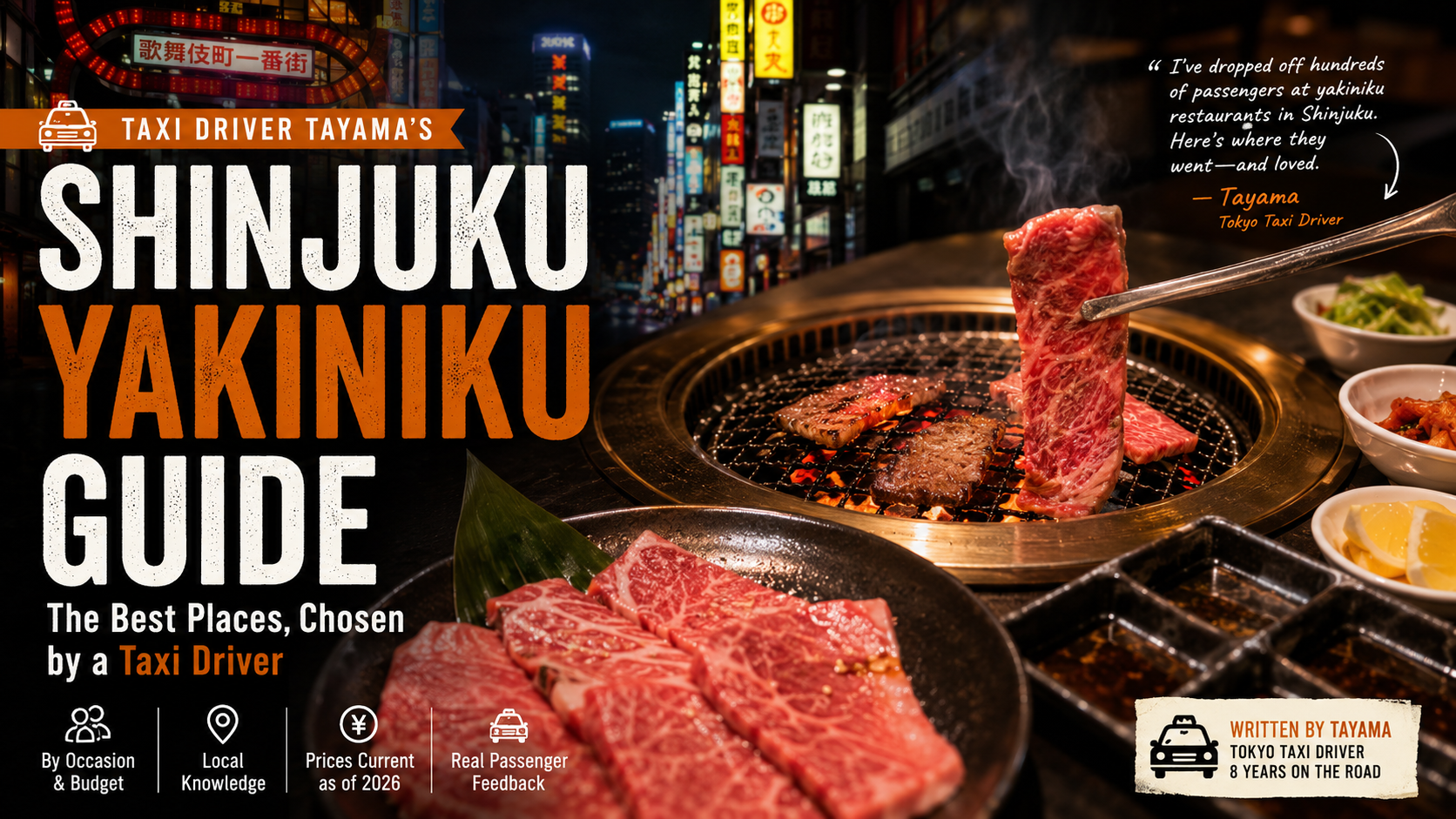
I’ve dropped off hundreds of passengers at yakiniku restaurants across Shinjuku over eight years. Wedding anniversaries, business dinners, first-timers from overseas who had never touched raw beef in their lives — I’ve watched them all disappear through the doors, and in the morning I’ve heard what they thought of it.
Shinjuku has more yakiniku restaurants per square kilometer than almost anywhere in Japan. That’s both a gift and a problem. The good news: whatever your budget, mood, or group size, there’s a perfect place within walking distance. The bad news: surrounded by hundreds of options, most visitors end up at whatever looks accessible rather than what’s actually great.
This guide is organized around how you’re actually traveling — not alphabetically, not by price ranking, but by the question every passenger eventually asks me: “Tayama-san, what kind of night is it going to be?” Answer that, and I’ll tell you exactly where to go.
🚖 About This Guide
Written by Tayama, Tokyo taxi driver with 8 years on the road. Restaurants are selected based on passenger feedback, personal visits, and cross-referencing Tabelog, Google Maps, and local driver knowledge. No sponsored placements. Prices current as of 2026 — always confirm directly before visiting.
Why Shinjuku Is Tokyo’s Definitive Yakiniku Destination
Yakiniku — the Japanese style of grilling thin-cut, carefully portioned meat over a tabletop grill — has roots across Japan, but the version you’ll experience in Shinjuku reflects something specific: the demands of a neighborhood that feeds three and a half million commuters a day while simultaneously catering to everyone from backpackers to visiting executives.
The competition here is fierce and the turnover rapid. A Shinjuku yakiniku restaurant that isn’t genuinely good doesn’t survive. The customer base knows their food — Tokyo office workers who eat out four or five nights a week don’t return to a mediocre place. That competitive pressure filters the landscape in a way that works in your favor.
100+
Yakiniku restaurants
within 10 min walk
¥2,800
Budget tabehoudai
(all-you-can-eat) from
24hr
Late-night options
open until 5 AM
From a taxi driver’s perspective, Shinjuku’s yakiniku geography breaks into three rough zones: the West Exit cluster (Nishi-Shinjuku) for mid-range and high-end, the East Exit / Kabukicho corridor for late-night, budget, and solo-friendly spots, and Shinjuku-sanchome for the more neighborhood-feel restaurants that locals actually return to.
How to Choose the Right Yakiniku Restaurant for Your Trip
The single biggest mistake visitors make is picking a restaurant based on price alone. Budget and experience type are entirely separate variables in Shinjuku. Here’s a quick-reference matrix before we get into specific recommendations.
🍖
First Time in Japan
Go for a mid-range tabehoudai with English menus. Low-pressure, you can try many cuts, and staff at these places are used to guiding first-timers.
→ See: Best All-You-Can-Eat
💎
Special Occasion
A5 Wagyu course dining. Book a week ahead, dress smart-casual, and let the evening unfold slowly. This is a Japan memory you’ll carry for years.
→ See: Best Wagyu Experience
🧍
Solo Traveler
Counter seating is your friend. Chains like Yakiniku Like are designed for exactly this. Zero awkwardness — solo dining is completely normal in Tokyo.
→ See: Best for Solo Travelers
👨👩👧
Family Trip
Choose tabehoudai with table seating, not counter. Look for places that list “children welcome” (子供OK) — not all yakiniku restaurants do.
→ See: Best All-You-Can-Eat
🌙
Late-Night Craving
Kabukicho has you covered past midnight. A handful of places run until 4–5 AM with real quality — not just survival food.
→ See: Best Late-Night Yakiniku
💴
Budget Conscious
¥3,000–¥4,000 all-in is genuinely achievable. The trick is knowing which budget spots cut corners on meat versus which cut corners on decor (acceptable).
→ See: Best Budget Yakiniku
Know Your Cuts: A Taxi Driver’s Meat Glossary
Before the restaurants, a quick primer. Japanese yakiniku menus can be intimidating — not because the concepts are complex, but because the cuts have Japanese names you won’t recognise. Here’s what you’ll see, and what to prioritise.
Essential Cuts & What They Mean
| Japanese Name | Cut / English | Flavour Profile | Best For |
|---|---|---|---|
| タン (Tan) | Beef tongue | Firm, savory, mild. Grills quickly. | Starting dish — order first |
| カルビ (Karubi) | Short rib / Kalbi | Rich, well-marbled, sweet fat. The classic. | First-timers, crowd pleaser |
| ロース (Rosu) | Sirloin / loin | Lean and beefy. More delicate marbling than karubi. | Those who prefer leaner meat |
| ハラミ (Harami) | Skirt steak / diaphragm | Deeply flavored, slightly chewy. Not fatty. | Experienced eaters, best value |
| ミノ (Mino) | Tripe (first stomach) | Chewy, neutral flavor, absorbs sauce well. | Adventurous eaters |
| ユッケ (Yukke) | Raw beef tartare | Silky, sweet, served with egg yolk and sesame. | Start or appetizer (where available) |
| ホルモン (Horumon) | Offal / organ cuts | Strong flavor, very tender when fresh. Polarising. | Those who know they like it |
🚖 Tayama’s Ordering Strategy
I always tell first-timers the same thing: start with tan (beef tongue) with salt and lemon — it’s the palate cleanser of yakiniku. Move to karubi for richness, then harami if you want something that tastes purely of beef. Finish with something premium if the budget allows. That arc — mild → rich → complex → premium — is how locals structure the meal. Don’t order everything at once.
Best Budget Yakiniku in Shinjuku
Budget in Shinjuku means under ¥4,000 per person for a full meal including drinks. The spots below won’t win design awards, but the meat quality is honest and the experience is genuinely local. These are the places taxi drivers actually eat.
Yakiniku Like — Shinjuku Nishiguchi Branch
焼肉ライク 新宿西口店
Yakiniku Like completely reinvented the solo dining problem. Individual grills built into each seat, single-portion sets, tablet ordering — the whole experience is designed so that eating alone at yakiniku feels intentional rather than improvised. The quality won’t make a purist weep, but for ¥1,500–¥2,500 you get a legitimate yakiniku experience with wagyu options, cold beer, and zero awkwardness.
This is the chain that made solo yakiniku mainstream in Japan. The Shinjuku Nishiguchi branch is busy but fast — typical turnover is 40–50 minutes, which suits the pace of the area perfectly.
- Best For
- Solo travelers, quick lunch, first-timers on a budget
- Signature Items
- Wagyu set, beef tongue, karubi rice bowl
- English Support
- Tablet ordering with English/multilingual options
- Nearest Station
- Shinjuku Nishiguchi (Oedo Line) — 1 min
- Hours
- 11:00–23:00 (varies by day)
- Reservation
- Walk-in only (fast turnover)
🚖 Taxi Driver’s Tip
Peak hours are 12:30–1:30 PM and 7–9 PM. Come at 6 PM or after 9:30 PM for no wait. The single-serving sets are genuinely filling — don’t over-order. The wagyu harami set is the best value on the menu.
Anan — Shinjuku Shokunin-dori Branch
安安 新宿職安通り店
Anan is the yakiniku chain that Tokyo locals actually choose when someone says “let’s grab some meat” on a Tuesday evening. No gimmicks, no performance dining — just reliable beef at prices that won’t make you calculate your remaining travel budget mid-meal. The Shokunin-dori branch sits on a street that taxi drivers know well: a strip north of Kabukicho where local workers eat.
The menu is extensive — karubi, harami, beef tongue, hormone cuts, pork — and the kitchen sources well for the price point. A la carte ordering means you control the spend. Two people eating freely with beer usually land around ¥3,000–¥3,500 each.
- Best For
- Groups of 2–6, local atmosphere, value drinking dinner
- Signature Items
- Kalbi, hormones, beef tongue with salt
- English Support
- Photo menu; some staff speak basic English
- Nearest Station
- Seibu Shinjuku — 3 min walk
- Hours
- 17:00 – midnight (weekdays), later on weekends
- Reservation
- Hotpepper / walk-in
🚖 Taxi Driver’s Tip
The street this sits on — Shokunin-dori — is a good signal in itself. Tourist-trap restaurants don’t survive long here because the clientele is locals who come back weekly. If you’re not sure what to order, ask for the “osusume” (recommendation) and point at yourself to indicate a budget range. They’ll sort you out.
Yakiniku Motoyama — Nishi-Shinjuku
焼肉 もとやま 西新宿店
This one surprised many passengers when I first mentioned it. Motoyama has been at its original Okachimachi location since 1975, and the Nishi-Shinjuku branch brings the same approach: A5-grade Kobe beef yakiniku at prices roughly 40% below comparable Wagyu restaurants. How? They buy whole cows directly and keep overheads low. The result is a restaurant that doesn’t look premium but serves the same beef that high-end places charge three times more for.
For ¥2,980 you can order the “Koyoi no Wagyu 3-sai” — three cuts of Kuroge Wagyu purchased that morning, including Kobe beef. It’s a remarkable price point for what arrives on the plate.
- Best For
- Wagyu curious on a budget, couples dinner
- Signature Items
- Koyoi no Wagyu 3-sai, rare cut assortment
- English Support
- Limited — photo menu, translation app recommended
- Nearest Station
- Shinjuku West Exit — 5 min / Nishi-Shinjuku (Oedo) — 1 min
- Hours
- 17:00 – 23:30 (L.O. 23:00), no regular closing day
- Reservation
- Recommended; walk-in often possible weeknights
🚖 Taxi Driver’s Tip
Motoyama is the open secret of Nishi-Shinjuku. The exterior won’t impress you. Walk in anyway. This is a restaurant that media in Japan has covered repeatedly for its quality-to-price ratio, and the regulars I’ve spoken to say it’s one of the most consistent yakiniku spots in the area. Go early or book — it fills up by 7 PM on weeknights.
Best Premium Wagyu Experience in Shinjuku
A proper A5 Wagyu yakiniku dinner is one of the most memorable meals you can have in Japan. The marbling levels, the texture, the way the fat dissolves at body temperature — it’s unlike any beef experience most visitors have encountered before. Budget ¥10,000–¥20,000 per person and book well ahead.
Yakiniku Ushigoro — Shinjuku-sanchome
焼肉うしごろ 新宿三丁目店
Every room at Ushigoro is a private room. Every piece of beef is A5-grade Japanese black cattle. This is not a restaurant you stumble into — it requires advance planning, a proper budget, and the understanding that you’re booking an experience rather than just a meal.
The approach here is what the Japanese call kodawari — obsessive attention to a single craft. Sourcing Wagyu directly, cutting it precisely, presenting it on custom ceramics in a room designed to hold no more than a handful of guests. The staff guide you through each cut with the quiet authority of someone who genuinely knows what they’re talking about.
For couples celebrating something significant, for business dinners that need to make an impression, or for any traveler who has been thinking about trying genuine premium Wagyu since before they boarded the plane — this is the answer.
- Best For
- Couples, special occasions, business dinners
- Signature Items
- A5 sirloin, Chateaubriand, thick-cut tongue
- English Support
- English menu available; reservation staff speak English
- Nearest Station
- Shinjuku-sanchome — 2 min walk
- Hours
- Dinner only, from 17:00. Check official site for latest.
- Reservation
- Essential — book 1 week+ ahead via TableCheck or phone
🚖 Taxi Driver’s Tip
Taxi drop-off: tell the driver “Shinjuku-sanchome, Nakamachi area” — the entrance is in a side street off the main Shinjuku-dori. The private room format means arrivals are staggered; don’t be surprised if the entrance feels quiet. That’s intentional. Once inside, the evening takes care of itself.
Yakiniku Ushi Jirushi — Shinjuku
焼肉 牛印 新宿店
Part of the Toraji Group — one of Japan’s most respected yakiniku companies — Ushi Jirushi takes the supply chain seriously in a way that shows on the plate. The Kuroge Wagyu here is raised at the Toraji Ranch, which means the restaurant controls quality from pasture to grill. The standout dishes are the Chateaubriand steak sandwich, the thick-cut beef tongue that takes several minutes to cook properly, and a truffle-enhanced sukiyaki that shouldn’t work as well as it does.
A dedicated master griller handles your meat rather than leaving it entirely to the diner. This removes the anxiety first-timers sometimes feel about overcooking expensive beef. For visitors who want the premium experience without the pressure of technique, it’s an excellent choice.
- Best For
- First premium yakiniku experience, couples, groups of 2–4
- Signature Items
- Chateaubriand sandwich, thick tongue, truffle sukiyaki
- English Support
- English menus, bilingual staff
- Nearest Station
- Shinjuku (various exits) — 5–8 min walk
- Hours
- Dinner courses; confirm via reservation
- Reservation
- Required — book online or by phone
🚖 Taxi Driver’s Tip
The griller-assistance service is worth requesting explicitly when you book if it’s your first time. Watching a professional grill A5 wagyu — the precise timing, the small movements, the moment they decide the meat is ready — is genuinely interesting as a piece of Japanese food culture.
Yuboku Shinjuku — Kabukicho
遊牧 新宿店
Yuboku occupies an unusual position in Shinjuku’s yakiniku landscape — it’s a genuine premium restaurant that is also open until 5 AM. The Kabukicho address means it serves the late-night crowd without compromising on the beef. A5 Yamagata and Yonezawa cattle are purchased whole, then dry-aged for five to ten days to concentrate flavor before serving.
The “Top-Quality Whole Cow Platter” is the best way to experience this — rare cuts that only exist because they buy the whole animal, served alongside the expected premium cuts. Both tatami and table seating available. Sake and shochu selection curated specifically to complement beef.
- Best For
- Late-night premium dining, adventurous eaters, dry-aging fans
- Signature Items
- Whole cow platter, thick beef tongue, Yonezawa sirloin
- English Support
- Moderate — photo menu, staff helpful
- Nearest Station
- Shinjuku East Exit — 6 min walk / Seibu Shinjuku — 3 min
- Hours
- 18:00 – 05:00 (L.O. 04:00), no regular closing day
- Reservation
- Recommended for evening; walk-in possible late night
🚖 Taxi Driver’s Tip
Address: Amimoto Building 1F, 2-26-3 Kabukicho. Tell a taxi driver “Kabukicho nii-chome, Amimoto Building” and they’ll find it. After midnight, this is one of the few places in Shinjuku where the beef quality doesn’t drop with the hour. The dry-aging makes the lean cuts taste as good as the marbled ones — unusual for yakiniku.
Best All-You-Can-Eat Yakiniku (Tabehoudai) in Shinjuku
Tabehoudai (食べ放題, all-you-can-eat) is one of the most genuinely enjoyable dining formats in Japan — you pay a flat fee, set a time limit (typically 90–120 minutes), and order freely from a menu. Quality ranges from “sufficient chain food” to “genuinely impressive premium beef.” The spots below lean toward the latter end of that spectrum.
Rokkasen — Nishi-Shinjuku Main Branch
六覚燈 西新宿本店
Rokkasen operates in a category of its own: premium all-you-can-eat with tableside service, private booths, and a menu that includes Matsusaka beef sirloin, Kobe rib eye, lobster, king crab, abalone, and scallops alongside unlimited drinks. The “Tsuki” course — the one most international visitors rave about — combines top-tier Wagyu with a serious seafood selection that most yakiniku restaurants don’t attempt.
Staff in kimono bring dishes as fast as you order them. The tablet ordering system means no awkward signaling for more food. Repeat visitors describe a rhythm of ordering in batches — a few wagyu cuts, some seafood, rest, repeat — that stretches a two-hour limit pleasurably.
Location: 10th floor of a building two minutes from Shinjuku Station West Exit, with views across Nishi-Shinjuku’s skyscrapers. Open from 11 AM to 5 AM daily, which makes it both a lunch option and a legitimately late-night one.
- Best For
- Groups, families, first premium yakiniku experience, tourists who want guaranteed English service
- Courses
- Multiple tiers; Tsuki course (AYCE Wagyu + seafood + unlimited drinks) most recommended
- English Support
- Full — English menus, multilingual staff, English-friendly reservation process
- Nearest Station
- Shinjuku Station West Exit — 2 min walk
- Hours
- 11:00 – 05:00 (L.O. 04:00), open daily
- Reservation
- Strongly recommended; online booking available in English
🚖 Taxi Driver’s Tip
Rokkasen is the AYCE answer I give to passengers who say “I want to try everything, and I want the whole thing to be easy.” It covers all scenarios — seafood and land, wagyu and beer — in a single booking. For visitors with limited nights in Tokyo who want premium but also breadth, this is the right call. Book the Tsuki course for the full experience, not the entry tier. The difference is significant.
Wagyu Horumon WAIGAYA — Shinjuku-sanchome
和牛ホルモン WAIGAYA 新宿三丁目店
The tabehoudai course at WAIGAYA runs for 2.5 hours and covers premium Kuroge Wagyu beef tongue, karubi, harami, yukke (raw beef tartare — only possible because the restaurant meets Japan’s strict raw meat certification), and unlimited soft drinks or alcohol depending on the tier chosen. The ¥11,000–¥12,000 price point for this quality level is difficult to match in Shinjuku.
The atmosphere is deliberately lively — the name WAIGAYA (ワイガヤ) is Japanese slang for “noisy and fun” — which makes it excellent for groups who want energy rather than refinement. One minute from Shinjuku-sanchome Station’s B2 exit.
- Best For
- Groups, birthday dinners, people who want AYCE wagyu at honest prices
- Signature Items
- Kuroge wagyu tongue, harami, yukke (raw beef tartare)
- English Support
- Moderate — photo menu, translation app helpful
- Nearest Station
- Shinjuku-sanchome Exit B2 — 1 min walk
- Hours
- Dinner from 17:00; confirm current hours
- Reservation
- Recommended — popular especially Fri/Sat
🚖 Taxi Driver’s Tip
The yukke here is worth ordering early — it’s one of those items that sets the tone for the meal. Not all yakiniku restaurants can legally serve raw beef in Japan due to certification requirements; places that have it usually do it properly. Order it in the first round, not after you’re full on karubi.
Gyukaku — Shinjuku Station branch
牛角 新宿店
Japan’s largest yakiniku chain and the honest answer when someone wants reliable, well-executed tabehoudai without the research overhead. Gyukaku’s Shinjuku branch is five minutes from the station, offers free Wi-Fi, full multilingual menus, and all-you-can-eat options alongside à la carte Kuroge Wagyu. Staff are experienced with international guests — this branch fields foreign visitors every single day.
The all-you-can-eat tier gives you access to a solid range of marinated and unmarinated beef, pork, chicken, vegetables, and side dishes. Nothing will astonish a wagyu connoisseur, but for families, first-timers, and anyone who wants a low-friction evening, Gyukaku delivers consistently.
- Best For
- Families, first-timers, groups wanting easy AYCE
- English Support
- Excellent — full multilingual menu, Wi-Fi, experienced international staff
- Nearest Station
- Shinjuku Station Exit B16 — 5 min walk
- Hours
- 16:00 – 23:00 (L.O. 22:00), irregular closing days
- Address
- B1F, Kotakibashi Pacifica Bldg., 7-10-18, Nishi-Shinjuku
- Reservation
- Recommended for groups; walk-in often possible
🚖 Taxi Driver’s Tip
Gyukaku is not exciting — it’s reliable. I recommend it to passengers who have never done yakiniku before and are a little nervous about the format, or to families with kids where the priority is “everyone eats well, no one stresses.” After a successful first yakiniku at Gyukaku, most people want to come back and try something more serious. It works as an on-ramp.
Best Hidden Local Yakiniku Spots
These are restaurants that don’t show up prominently in English-language guides, don’t have PR budgets, and survive entirely on repeat local customers. Navigating them requires a translation app and some patience — but that’s exactly why the food is worth it.
Yakiniku Nikunone — Kabukicho backstreets
焼肉 にくの音
Nikunone consistently surfaces in “hidden gem” searches precisely because the regulars keep recommending it and the restaurant doesn’t market itself aggressively. The beef quality is above what the price and location would suggest — it sits in the Kabukicho back streets that most tourists never reach, surrounded by the kind of clientele that eats yakiniku several times a month.
The atmosphere is casual and slightly smoky in the way good yakiniku bars should be. Counter seating and small tables make it comfortable for solo diners as well as pairs. Portions are generous. The staff are patient with the translation app.
- Best For
- Local atmosphere seekers, solo, pairs
- Nearest Station
- Seibu Shinjuku — 5 min walk
- English Support
- Limited — photo menu essential, staff patient
- Reservation
- Walk-in or Hotpepper
🚖 Taxi Driver’s Tip
The Google Maps reviews at Nikunone are unusually consistent — you’ll see comments like “stumbled across this and it was the best yakiniku of the trip.” That’s the signature of a place that survives on quality rather than location. High ratings with mostly Japanese reviewers is a better signal than English-language buzz.
Yakiniku Goku — Shinjuku-sanchome
焼肉 ごく
Address: Cross Building 103, 3-8-2 Shinjuku. The interior is dark, deliberately unhurried, and makes you feel you’ve found something the guidebooks missed. The chef’s omakase course — two meats selected that day plus two “secret menu” items not listed anywhere — is the reason regulars keep returning.
The menu is broad enough that you could visit multiple times without repetition. Assorted meat platters in small portions allow curious diners to range widely without commitment. Hours: Monday–Thursday until 1 AM, Friday–Saturday until 1 AM, Sunday until 11 PM.
- Best For
- Adventurous eaters, couples, small groups who want a “discovered” experience
- Signature
- Chef’s omakase course, rare cuts, meat assortment platters
- Nearest Station
- Shinjuku-sanchome — 2 min walk
- English Support
- Limited; translation app works fine
🚖 Taxi Driver’s Tip
“A place I won’t tire of even visiting weekly” is how locals describe Goku — that quote comes directly from Japanese food media coverage. Restaurants that earn that kind of loyalty from regulars are the ones to find. The dim interior and quiet atmosphere make it a good choice for a conversation-heavy dinner where you want to focus on the company as much as the food.
Best Late-Night Yakiniku in Shinjuku
After the last trains stop (around 12:30–1 AM on most Shinjuku lines), getting a proper meal in Tokyo requires knowing where to go. These are the places I personally pull up to after a long night shift. Quality doesn’t have to drop with the hour — these spots prove it.
Yakiniku Kanau — Shinjuku-sanchome
焼肉 叶 新宿三丁目
Open every day of the year, every day until 5 AM. That operational consistency alone makes Kanau remarkable — running a kitchen at that standard, without closing days, requires genuine commitment to quality rather than just staying open to catch the post-midnight crowd.
The name means “dreams come true” in Japanese, and there’s a genuinely charming local custom here: the restaurant will give you an ema (a small wooden votive board) to write a wish on if you ask. It’s the kind of detail that exists because the owner wanted it there, not because a marketing team suggested it.
The restaurant holds a rare raw meat certification — their yukke (beef tartare) is made from beef that meets Japan’s strict standards for raw serving. Order it. The natural sweetness of raw Wagyu mixed with egg yolk and sesame is something that doesn’t translate into any description — it just has to be eaten.
- Best For
- Late-night dining, solo travelers, couples, anyone who misses the last train
- Signature Items
- Yukke (raw beef tartare), premium wagyu cuts, certified fresh beef
- English Support
- Moderate — helpful staff, translation app works
- Hours
- Open 365 days/year, until 5 AM daily
- Nearest Station
- Shinjuku-sanchome — 1–2 min walk
- Reservation
- Walk-in fine for late-night; book in advance for prime evening slots
🚖 Taxi Driver’s Tip
Kanau is my honest recommendation for visitors who’ve missed the last train and find themselves unexpectedly in Shinjuku at 1:30 AM needing a proper meal before deciding what to do next. It’s also just a good restaurant at any hour — the late-night hours are a bonus, not the main draw. Ask about the ema. Write something on it. Leave it.
🌙 Late-Night Quick Reference
Yuboku Shinjuku
Kabukicho / Until 5 AM
A5 Wagyu, dry-aged cuts
Yakiniku Kanau
Shinjuku-sanchome / Until 5 AM
Open 365 days, yukke specialist
Rokkasen
Nishi-Shinjuku / Until 5 AM
AYCE Wagyu + seafood, premium
Best Yakiniku for Solo Travelers
Japan is one of the most solo-diner-friendly countries on earth, and the yakiniku category has evolved accordingly. The spots below offer counter seating, individual grills, or a format that makes eating alone feel completely natural rather than awkward.
Jojoen — Shinjuku Odakyu Halc Branch
叙々苑 新宿小田急ハルク店
Jojoen is one of Japan’s most recognized yakiniku brands — the kind of place that appears in Japanese popular culture as a destination for celebrations and first dates. The Halc building branch in Shinjuku is accessible, has counter seating suitable for solo dining, and offers a quality benchmark that visitors can compare against later experiences.
For solo travelers who want their first yakiniku experience to feel properly Japanese — attentive service, quality beef, unhurried — Jojoen delivers that without requiring advance planning far beyond the week you arrive. The lunch sets at around ¥2,000 represent exceptional value compared to dinner pricing.
- Best For
- Solo first-timers, those who want brand-name quality assurance
- Lunch
- Excellent value — sets from approx. ¥2,000
- English Support
- Good — menu available in English
- Nearest Station
- Shinjuku Station — inside Odakyu Halc building, 1 min
- Hours
- Lunch from 11:30, dinner from 17:00 (confirm hours)
- Reservation
- Recommended for dinner; walk-in for lunch usually fine
🚖 Taxi Driver’s Tip
Jojoen lunch is one of the best-kept secrets for the solo budget traveler who wants a genuine experience without dinner pricing. The beef quality at lunch is the same as dinner — the format is just more compact. Go for the set that includes karubi and tongue; it covers both the classics in one booking.
🧍 Solo Yakiniku Survival Guide
- → Ask for カウンター席 (kauntaa seki) — counter seat. Most staff will understand.
- → Individual grill restaurants (like Yakiniku Like) are explicitly designed for solo dining — no awkwardness at all.
- → Counter seats at most yakiniku places have the grill built into the counter. Sit, order, grill, eat. Nobody watches.
- → Lunch solo is even more natural than dinner solo — many restaurants get single business diners throughout the day.
Yakiniku Etiquette & How to Grill Like a Local
Yakiniku doesn’t have rigid rules — it’s a relaxed format — but there are a few habits that mark you as someone who knows what they’re doing. These are the things I’d tell a first-timer before they walked in.
🔥
Grill Management
Don’t crowd the grill. One or two pieces at a time, leaving space between them. Overcrowded grill = steamed meat, not grilled meat. Flip only once. The Maillard crust on the first side is where flavor lives.
🥢
Separate Chopsticks
Use the tongs or the serving chopsticks to handle raw meat on the grill. Use separate chopsticks to eat the cooked meat. Most restaurants provide two sets precisely for this. It’s not obsessive — it’s the correct way.
📋
Order in Waves
Order three or four items at a time, eat them, then order the next round. Ordering everything upfront results in cold food and a crowded table. Start with tongue, move to karubi, then the more complex cuts.
⏱️
Grill Replacement
Most restaurants replace the grill net partway through your meal when it gets too charred. If they don’t offer one after 30–40 minutes of heavy grilling, it’s fine to ask: “Ami, kaete itadakemasu ka?” (Could you replace the grill net?)
🥬
The Role of Vegetables
Korean-style kimchi and pickled vegetables are palate cleansers, not afterthoughts. A bite of kimchi between cuts resets your perception of richness. The mushrooms and onions on the grill are not filler — they absorb the beef fat and become excellent.
🍺
What to Drink
Beer is the default. Cold lager cuts through the fat beautifully. Highball (whisky and soda) is increasingly popular and works well with heavier cuts. For premium wagyu, some sake or shochu enthusiasts argue it complements the beef better than beer.
Useful Japanese Phrases for Yakiniku
You don’t need to speak Japanese to eat well at a yakiniku restaurant. But these phrases — said with confidence or shown on your phone — smooth the experience considerably.
Essential Phrases
Area Map: Where to Find Yakiniku in Shinjuku
Shinjuku’s yakiniku landscape clusters into three zones. Understanding which zone serves your needs saves time and often improves the experience.
🏢 West Exit / Nishi-Shinjuku
Best for: Premium dining, AYCE, groups
- ✦ Rokkasen (AYCE premium)
- ✦ Yakiniku Motoyama (value wagyu)
- ✦ Jojoen Halc (institution)
- ✦ Yakiniku Like (solo-friendly)
- ✦ Gyukaku (family AYCE)
Walk from JR Shinjuku West Exit: 1–7 min
🌃 Kabukicho / East Side
Best for: Late night, local atmosphere, budget
- ✦ Yuboku (dry-aged, til 5 AM)
- ✦ Anan Shokunin-dori (local chain)
- ✦ Yakiniku Nikunone (hidden gem)
- ✦ Various late-night spots
Walk from JR Shinjuku East Exit: 3–10 min
🏘️ Shinjuku-sanchome
Best for: Neighborhood feel, hidden gems, late night
- ✦ Ushigoro (premium, all private)
- ✦ Yakiniku Goku (omakase course)
- ✦ WAIGAYA (wagyu AYCE)
- ✦ Yakiniku Kanau (365 days, 5 AM)
Tokyo Metro Marunouchi/Fukutoshin: 1 min by train or 7 min walk
Frequently Asked Questions
What is the difference between yakiniku and Korean BBQ?
How much should I budget for yakiniku in Shinjuku?
Do I need to reserve a table at yakiniku restaurants in Shinjuku?
What is A5 Wagyu and is it worth the price?
Are there vegetarian or halal-friendly yakiniku options in Shinjuku?
What is tabehoudai and how does it work?
What time is best to avoid queues at popular yakiniku spots?
Can I eat at a yakiniku restaurant in Shinjuku without speaking Japanese?
What’s the etiquette around smoke at yakiniku restaurants?
Is it okay to order only a few items rather than a full course?
Quick Comparison: All Recommended Restaurants at a Glance
| Restaurant | Price/person | Best For | English | Late Night |
|---|---|---|---|---|
| Yakiniku Like | ¥1,500–¥2,500 | Solo, quick | ✓ Tablet | Until 23:00 |
| Anan | ¥2,000–¥3,500 | Local vibe, groups | △ Photo menu | Until midnight+ |
| Yakiniku Motoyama | ¥3,000–¥5,000 | Value Wagyu | △ Photo menu | Until 23:30 |
| Jojoen (Halc) | ¥5,000–¥10,000 | Solo, first-timer | ✓ English menu | Until 22:00 |
| Gyukaku | ¥3,500–¥5,000 (AYCE) | Family, AYCE entry | ✓ Multilingual | Until 23:00 |
| WAIGAYA | ¥11,000–¥12,000 (AYCE) | Groups, wagyu AYCE | △ Photo menu | Until 23:00 |
| Rokkasen | ¥12,000–¥45,000 (AYCE) | Premium AYCE, groups | ✓ Full English | Until 5 AM ✓ |
| Yakiniku Nikunone | ¥4,000–¥7,000 | Local atmosphere | ✗ Translation app | Late hours |
| Yakiniku Goku | ¥4,000–¥6,000 | Hidden gem, omakase | ✗ Translation app | Until 1 AM |
| Yakiniku Ushigoro | ¥15,000–¥25,000 | Premium, occasion | ✓ English menu | Dinner only |
| Ushi Jirushi | ¥13,000–¥20,000 | Premium, Toraji group | ✓ Bilingual staff | Dinner only |
| Yuboku Shinjuku | ¥5,000–¥8,000 | Late night premium | △ Moderate | Until 5 AM ✓ |
| Yakiniku Kanau | ¥4,000–¥6,000 | Late night, 365 days | △ Moderate | Until 5 AM ✓ |
Final Recommendation from Taxi Driver Tayama
Shinjuku doesn’t make choosing yakiniku easy — that’s part of what makes it remarkable. The options are genuinely overwhelming until you find your frame for thinking about them.
My honest advice, distilled from eight years of driving past, dropping off at, and occasionally eating at these restaurants:
- If you have one night — Book Rokkasen’s Tsuki course. It covers everything in a single dinner: Wagyu, seafood, unlimited drinks, English service, and a view. You won’t regret it.
- If budget is the priority — Yakiniku Motoyama for a real Kobe beef experience at chain restaurant prices, or Anan for a proper local evening with cold beer.
- If you want a memory — Ushigoro. Private room, A5 only, total focus on the beef. This is the meal you’ll describe to people back home.
- If you’re solo — Start at Yakiniku Like to get comfortable with the format, then upgrade to Jojoen for a proper counter experience.
- If you’ve missed the last train — Yakiniku Kanau in Shinjuku-sanchome. Open until 5 AM, 365 days. The yukke is worth the detour regardless of the hour.
One last thing. When the food is this good and the city this alive outside, it’s easy to rush. Don’t. The Japanese phrase hara hachi bu — eat until you’re eighty percent full — sounds like a diet tip but is really about appreciating the meal while you can still taste it clearly. Order in waves. Grill slowly. Drink at whatever pace the evening demands.
Shinjuku at 9 PM with a glass of cold beer and A5 karubi on the grill is, to my mind, one of the better places to be on earth.
I’ll see you on the road.
— Tayama | Tokyo Taxi Driver
8 years on the road in Tokyo. Writing at TAKE ME THERE JAPAN and taxi-tenshoku.net. Last updated: June 2026. Prices and hours change — always confirm before visiting.
📍 Continue Exploring Shinjuku