
Japanese Curry in Shinjuku The Comfort Food Nobody Expects to Love

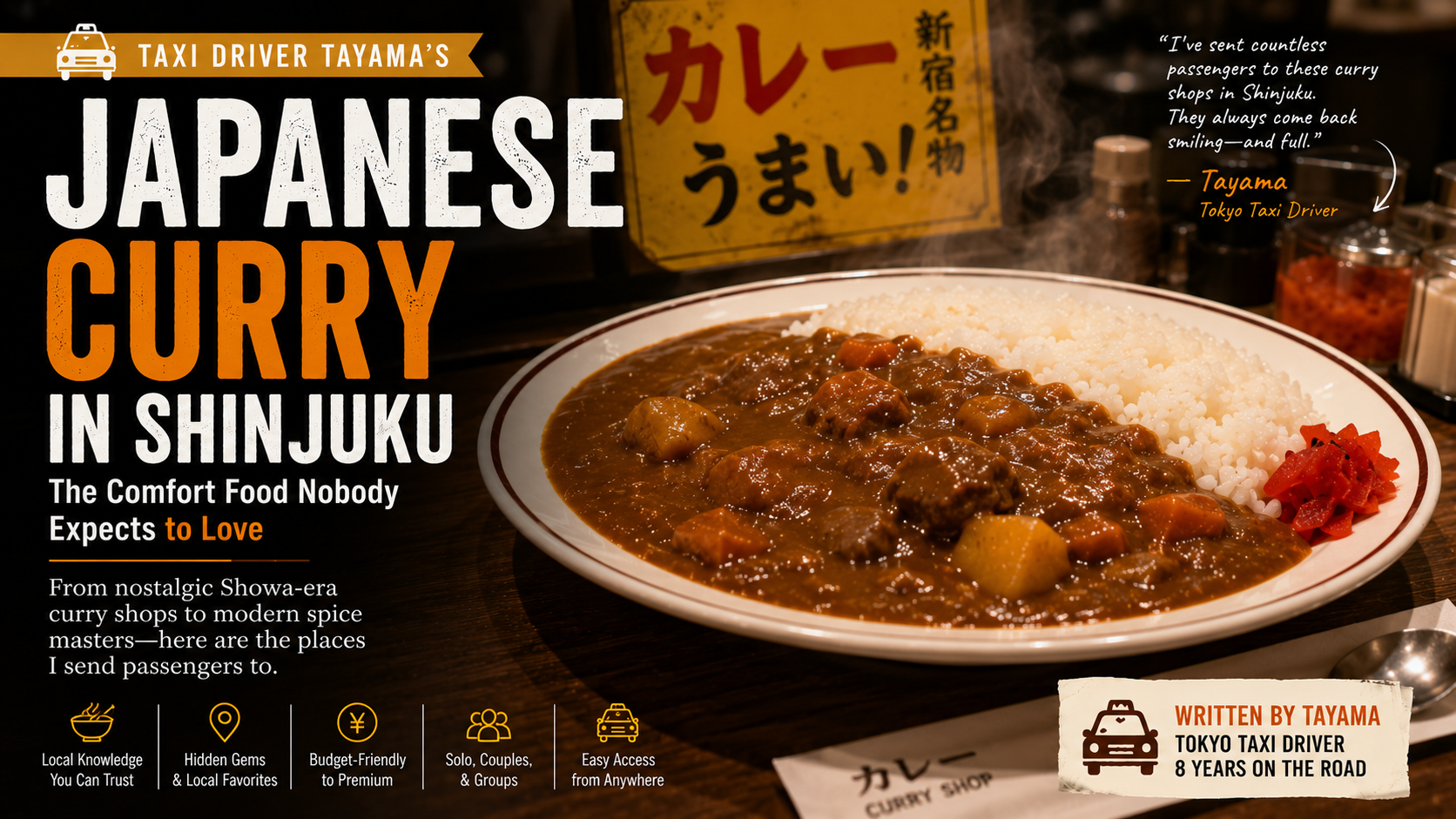
Japanese curry is one of those foods that surprises people. They expect something like the Indian curry they know — aromatic, thin, complex. What arrives instead is something thick, slightly sweet, deeply savoury, and served over a mound of Japanese rice with fukujinzuke pickles on the side. The first spoonful usually produces a pause. Then they eat the whole bowl and wonder why nobody told them about this sooner.
In Shinjuku, there is a curry restaurant that has been serving the same dish since 1927. Another that has served the same katsu curry since 1964. Another that lets you customise spice levels across ten degrees from zero to “do you have medical insurance?” These are not gimmick restaurants. They are part of daily life for the millions of people who live and work in this neighbourhood.
The short answer: everything. Japanese curry and Indian curry share an ancestor — both derive from spiced dishes that arrived in Japan via the British in the late 19th century. But the British version had already been modified: curry powder replaced whole spices, the sauce was thickened with flour, and sweetness replaced heat as the dominant flavour note. Japan took that British interpretation and adapted it further over the next century, producing something entirely its own.
Where Indian curry uses liquid coconut milk, tomato, or yogurt as the base, Japanese curry uses a thick, roux-based sauce. Most home cooks make it from commercial curry blocks — small waxy cubes of compressed roux sold in every supermarket. Restaurant versions are more complex, often simmered for hours with caramelised onions, apple, honey, and a proprietary spice blend. The result is a glossy, thick sauce that coats the rice rather than pools around it.
Japanese curry is mild to medium in heat, with a pronounced sweetness at the front of the palate. Many recipes include apple or honey. The depth comes from slow-caramelised onion, which provides a round, slightly nutty base. The spicing is warm rather than aromatic — cumin, turmeric, coriander — but quieter than Indian curry. Foreign visitors often describe it as tasting “like a Sunday roast in spice form.” That’s not inaccurate.
Almost always with Japanese short-grain rice on the right side of the plate, curry sauce on the left, eaten by sliding rice into the sauce and eating from left to right. Fukujinzuke — finely chopped pickled vegetables dyed bright red — is served on the side as a palate cleanser. Rakkyo (pickled shallots) appear at more traditional restaurants. Both are there to cut through the richness of the sauce. Eat them.
The story begins in the late Meiji period (1868–1912), when Japan was aggressively adopting Western culture. The British Royal Navy had introduced curry to Indian ports as a shipboard staple, and when the Japanese Imperial Navy modelled its fleet organisation on Britain’s, curry came with it. Naval curry — kaigun curry — was standardised across the fleet and served every Friday, a tradition that continues in the Japanese Maritime Self-Defence Force to this day. The navy needed a calorie-dense, easy-to-serve dish that could be made in bulk. Curry, thickened with flour and adapted to Japanese rice, was perfect.
But the most remarkable chapter in Japanese curry’s history happened in Shinjuku in 1927, in a building that still stands. An Indian revolutionary named Rash Behari Bose had been sheltering at the Nakamuraya bakery since 1915, hidden from British agents. He married the bakery owner’s daughter, Toshiko, who died young in 1925. To help his grieving in-laws revive their struggling business, Bose introduced a curry using his mother’s spice knowledge — over 20 spices, slow-cooked with bone-in chicken. He called it “Pure Indian Curry.” The Japanese press named it the “Taste of Love and Revolution.” It became a phenomenon, and Nakamuraya’s building in Shinjuku still serves it today.
The post-war period democratised curry completely. S&B Foods and House Foods introduced ready-made curry blocks in the 1950s, and by the 1960s, curry rice had become Japan’s most cooked home dish. School cafeterias nationwide served curry every Friday. The CoCo Ichibanya chain, founded in 1978, made it a fast-casual staple. Today Japan consumes around 700 million servings of curry per year. That is roughly six servings for every person in the country.
The classic. Thick roux-based sauce over Japanese short-grain rice. The foundation of all Japanese curry culture.
Curry rice topped with tonkatsu — a deep-fried breaded pork cutlet. Japan’s most satisfying combination of textures.
Slow-cooked beef in a rich, dark sauce. Served at old-school yoshoku restaurants that have been making it for decades.
A recent movement: chef-driven curry using South Asian spice techniques, moving away from roux. More aromatic and dry than classic curry.
A Sapporo specialty that arrived in Tokyo. Thin, aromatic broth instead of thick roux, with whole vegetables and protein on the side.
Minced meat curry — usually pork or chicken, finely crumbled and dry-fried with spices. More intense per spoonful than standard curry rice.
Every travel forum about Japan eventually asks: “Is CoCo Ichibanya worth it?” The chain has locations across Shinjuku and is genuinely good — highly customisable spice levels (1 through 10, with a “special” level that requires a signed waiver at some branches), a wide topping menu, and reliable quality. It is the McDonald’s of Japanese curry: consistent, accessible, and not the reason to come to Shinjuku. The restaurants in this guide offer something CoCo cannot — a specific version of curry that belongs to one place, made by one chef or family, refined over decades. Both have a role. This guide is about the latter.
- First time eating Japanese curry? → Ganji or Mon Snack — classic, accessible, no surprises
- Want the most famous curry in Shinjuku? → Nakamuraya Manna — historic and worth the price
- Want katsu curry specifically? → Ohroji (王ろじ) or Mon Snack
- Want something spicy and modern? → Tokyo Dominica (soup curry) or Mooyan Curry
- Tight budget? → Mooyan Curry lunch buffet (weekdays only) or Iwamoto Q
- Eating alone? → Any counter-seat restaurant — this is solo food by design
- Open late? → Masala Station (until 7 AM weekdays) or CoCo Ichibanya
- Vegetarian? → Curry Kusamakura or Mooyan Curry (ask about options)
Classic Japanese curry — the thick, slightly sweet, long-simmered kind — is the category most visitors imagine when they picture Japanese curry. These restaurants have been making essentially the same dish for decades. They don’t use recipe cards anymore. The chefs know the sauce by feel.
Gandhi is in a narrow building off a side street near Shinjuku-Sanchome Station — 2nd floor, easy to miss, perpetually full from 11:30 onwards. This is exactly the kind of place this guide exists to tell you about. The beef curry arrives in a deep plate, rice and sauce presented separately so you control the ratio. The beef: large chunks, slow-cooked until they yield at the touch of a fork. The sauce: dark, intense, properly spicy — this is one of the few classic curry restaurants in Shinjuku that doesn’t apologise for heat. Gandhi doesn’t offer spice adjustment, which is a feature rather than a limitation. If it’s too much, add the slice of cheese that comes with the dish.
Founded decades ago and operating from the same building, Gandhi is known among Tokyo curry lovers as an institution — the kind of place where regulars have been eating the same thing once a week for years. No English menu, but the staff are used to pointing at photos for international visitors. Counter seating on a narrow bench, about 22 seats total.
Mooyan is a genuine curiosity: a daytime curry buffet restaurant that transforms into a drinking spot in the evening. The lunch buffet (weekdays only) charges around ¥1,500 for unlimited curry, rice, and side dishes. The curry itself is notable — Mooyan claims their sauce is the first gluten-free curry roux in the Japanese restaurant industry, slowly simmered and aged for about two weeks before service. The result is a sauce with unusual depth: sweet, rich, with a slightly fermented quality that sets it apart from standard yoshoku curry. The interior is chaotic and charming — a cross between a canteen and an izakaya, decorated with manga panels and hanging lanterns. Sixty-one seats, large enough for groups.
The spice sauce system lets you customise heat by ladling from several levels alongside the main curry. Bring an appetite and arrive before noon — the most popular items run out.
Katsu curry deserves its own section because it is arguably Japan’s greatest contribution to the universe of dishes where fried meat meets sauce. The combination of crispy tonkatsu — a thick pork cutlet fried in panko breadcrumbs — and thick, sweet curry sauce produces something that is greater than the sum of its parts. The crispy exterior of the katsu gradually softens in the sauce over the course of the meal, giving you two distinct textural experiences in one bowl.
The history of katsu curry is largely connected to yoshoku restaurants — Western-influenced Japanese eateries that emerged in the Meiji period. The dish became popular in the Showa era and has been standard on Japanese menus ever since. Ohroji and Mon Snack both claim historic versions that have barely changed since they opened.
Ohroji is a tonkatsu specialist that also makes one of the most respected katsu curries in Shinjuku. The distinction matters: this is a tonkatsu restaurant that happens to serve curry, not a curry restaurant that adds a pork cutlet as an afterthought. The pork is thick, tender, and fried to order with a thin, crackling batter. The curry sauce has a clear, concentrated spice character — well-seasoned but not overwhelming. It is served as “Tondomburi” in a round white bowl, three pieces of katsu sitting on top of curry rice: visually striking and genuinely delicious.
Ohroji has limited hours and closes on Wednesdays (plus Tuesday dinner), so plan carefully. It fills up fast at lunch and dinner, despite having 34 seats. Counter seating available.
Mon Snack opened in 1964 in the basement of the Kinokuniya bookstore building, and has remained there ever since, serving essentially the same curry to a counter of 13 seats with celebrity photos covering the walls. The curry at Mon Snack is unlike any other in Shinjuku: the roux is deliberately thin — more like a dark soup than a paste — and fruit chutney is added to produce a tart sweetness. The katsu is fried to order with a thin batter that stays crispy even as it sinks into the sauce.
The correct way to eat Mon Snack’s katsu curry, according to regulars, is to dip just the tip of the katsu into the sauce before each bite — not to drown it. This preserves the textural contrast. Japanese celebrities have been photographed here since the 1970s; their signed photos line the walls. Expect a wait of 10–20 minutes at peak lunch. Counter only. No reservation.
Nakamuraya Manna is not just a restaurant; it is a piece of Japanese history. The “Pure Indian Curry” served here has been on the menu since 1927, when an Indian revolutionary named Rash Behari Bose introduced it after sheltering at the Nakamuraya bakery from British agents. The dish — bone-in chicken cooked in a blend of over 20 spices, served with Japanese white rice and pickles — became the first authentic Indian-influenced curry to be commercially served in Japan. The print media of the time called it the “Taste of Love and Revolution.”
Today, the restaurant occupies a spacious B2 dining room beneath the Nakamuraya building (renovated in 2015), with vintage photographs of Bose and the Soma family in the entrance hall. The curry itself has been faithfully preserved: aromatic rather than heavy, the spice profile closer to an Indian kari than anything else on this list. Lunch sets start at ¥2,500; the Bengal Beef Curry (limited quantity) is a premium item worth ordering if available. Full English menus provided, and staff speak enough English for an easy visit. Not a budget option — but a meal that comes with a story that justifies the price.
Soup curry is a Sapporo speciality that has been steadily conquering Tokyo over the past decade. Unlike standard Japanese curry, soup curry uses a thin, aromatic broth — the consistency of a clear dashi — rather than a thick roux. The vegetables and protein sit alongside the broth rather than inside it: a whole chicken drumstick, roasted pumpkin, broccoli, boiled egg, all visible above the surface. You dip them into the broth as you eat.
Tokyo Dominica offers five different soup bases — classic yellow, white (soy milk), black (squid ink variant), and two seasonal options — each with spice levels from −10 (essentially no heat) to +10 (medically inadvisable). The tsukune soup curry — chicken meatballs in the house broth — is the standout order: the meatballs are dense and flavourful, absorbing the broth over the course of the meal. Lunch queue is substantial; arrive before 11:30 or after 13:30.
Japanese curry is inherently a budget-friendly category. Most of the restaurants on this list charge under ¥1,500. But there are options that push the value proposition further: large portions for small prices, or combinations that deliver more than the price suggests.
Kanoya is a standing counter shop near the West Exit of Shinjuku Station, primarily a soba and udon restaurant that also serves curry rice and curry udon. This is the kind of place that costs ¥500–700 and takes 8 minutes start to finish. The curry is not complex — it’s the hot, thick, reliable version that salaryman Japan has been eating at standing counters for 60 years. It is genuinely good. Not a destination; a solution. If you’re between trains, between tourist sites, or just need something hot and substantial for very little money, Kanoya delivers.
Japanese curry restaurants are almost uniquely suited to solo dining. Counter seating is the dominant format. No one speaks to you. No one rushes you. The bowl arrives in three minutes. You eat, pay, leave. The whole experience takes 15–20 minutes if you want it to, or 45 minutes if you want to sit quietly and watch the kitchen. Either is completely acceptable.
- Best counter for solo: Mon Snack (13 seats, all counter, completely normal to be alone)
- Quietest experience: Gandhi on a weekday afternoon — 22 seats, low conversation, focused on the food
- Most solo-friendly chain: CoCo Ichibanya — tablet ordering, no judgement, endlessly customisable
- Best value for solo: Mooyan Curry buffet — you set the pace and portion
- Phrase to know: “Hitori desu” (一人です) — “I’m dining alone” — hold up one finger
Kusamakura sits on a residential side street one block from Shinjuku-dori, close enough to Shinjuku Gyoen that you can smell the park from the pavement. It is a tiny, 20-seat restaurant used primarily by local office workers and residents — the kind of place that never appears on tour itineraries but appears on every “hidden gems” list compiled by people who live in the neighbourhood. The signature dish: chicken curry made with a whole onion per serving, slow-cooked overnight. The spice level runs from 1 to 10; level 5 is genuinely spicy by Tokyo standards. Takeaway available, which means you can get curry to eat in Shinjuku Gyoen park — one of the better picnic upgrades available in Tokyo.
Curry restaurants in Japan are among the most straightforward to navigate for non-Japanese speakers. Many use vending machine ordering. Those that don’t usually have picture menus. The only complexity is the customisation system, which varies by restaurant.
CoCo Ichibanya uses 1–10. Most others use a verbal system: “futsuu” (normal), “kara-me” (spicier), “ama-me” (milder). Tokyo Dominica goes −10 to +10. When unsure, start at the standard level.
“Futsuu” = standard (300g). “Oomori” = large (often free at budget shops). “Sukuname” or “chiisame” = small. Many places don’t advertise the large size — just ask.
At CoCo Ichibanya: cheese, spinach, fried egg, natto, sausage, and dozens more. At classic shops: often just cheese to mellow the heat. At soup curry shops: choose your protein and vegetable combination.
Onsen tamago (hot spring egg, soft-set) is a popular topping that adds richness. Kakitama (stirred egg in hot curry) is available at some shops. A fried egg on top is common at yoshoku-style restaurants.
The red pickled vegetable relish served alongside curry. Not optional — it is there to reset your palate between bites. Eat a small amount with each few spoonfuls of curry. Rakkyo (pickled shallot) serves the same function.
At buffet-style restaurants, ask “karee no okawari dekimasu ka?” At individual portion restaurants, extra sauce is usually charged at ¥100–200. Say “karee o sukoshi moratte ii desu ka?” (can I have a little more curry?)
I eat Japanese curry more than any other food. Not because it’s the best thing in Tokyo — it isn’t. But it’s available at any hour, always costs under ¥1,500, takes no more than 20 minutes, and never disappoints. In that sense it’s the perfect taxi driver’s meal.
If I’m sending a first-time visitor somewhere for Japanese curry in Shinjuku, it’s Nakamuraya Manna — not because the food is the best curry I’ve eaten (Gandhi’s beef curry has more character), but because the story is worth something. You’re eating a dish that an Indian revolutionary introduced to Japan in 1927. That’s not nothing. The building is walking distance from the station, the staff are kind, and the Nine Jewels vegetable curry is one of the most quietly beautiful dishes I’ve eaten anywhere in Tokyo.
For a real local experience — the kind where nobody looks at you twice and the food is just excellent — go to Gandhi. Order the beef curry. Get there before noon or after 1:30 PM. Put cheese on it if it’s too hot. Walk away happy.
And if you want to understand why Japanese curry exists at all — why 700 million bowls of this specific thing are eaten every year in a country of 125 million people — order the kamatama-style curry at any yoshoku restaurant with a history. It tastes like something that has been loved for a very long time.