
shinjuku-steak-guide

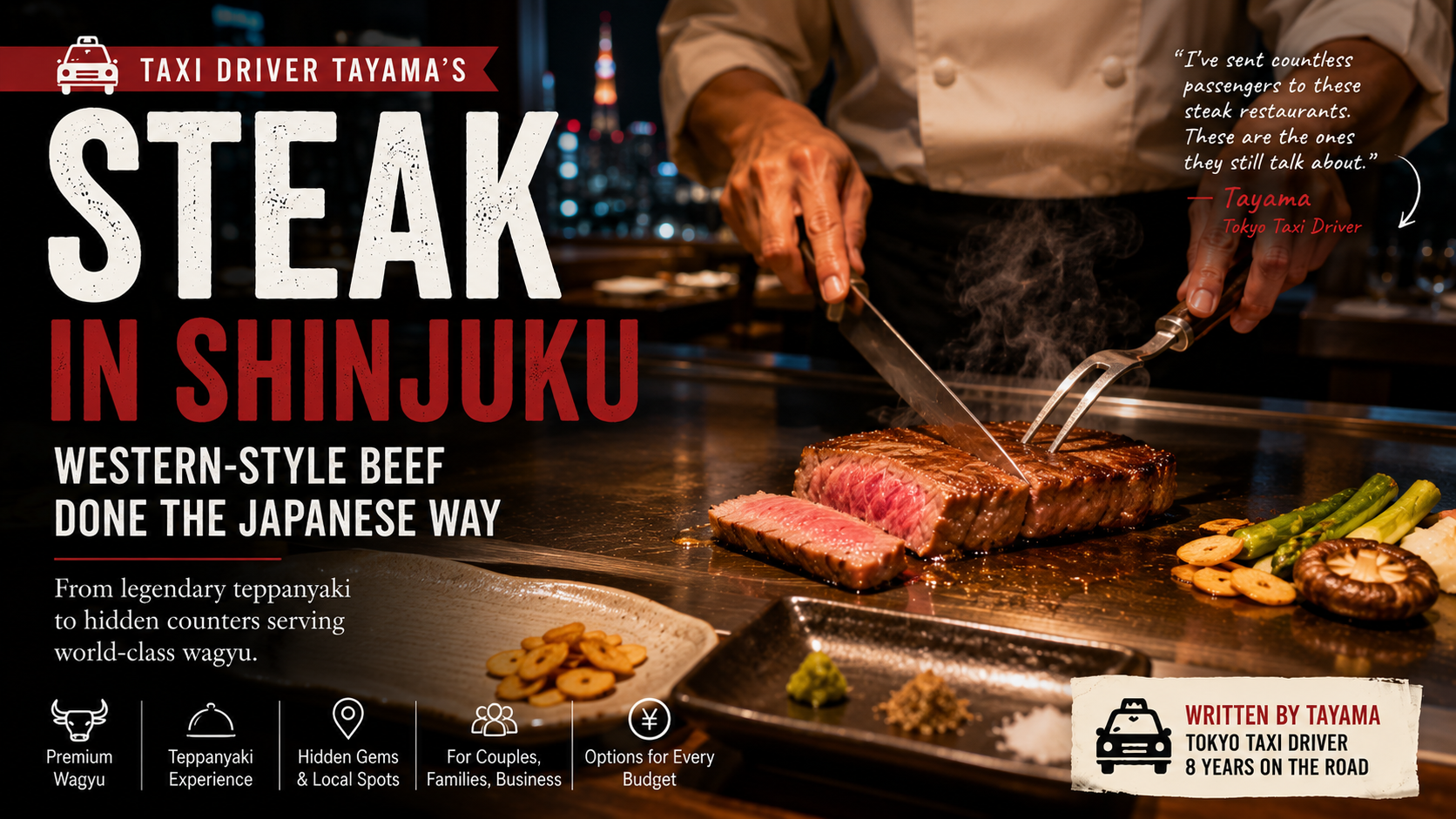
People ask me about steak more than almost any other food in Shinjuku. And the conversation usually goes the same way: they’ve eaten wagyu beef in their home country — at a Japanese steakhouse, or from an imported A5 shipment — and they’re wondering if coming to Japan changes anything. It does. It changes almost everything.
Japanese steak in Shinjuku isn’t just beef that happens to be cooked in Japan. The entire system — the cattle breeding philosophy, the grading standards, the cooking format, the service choreography, the side dishes, the meal structure — was built around a completely different set of values than Western steakhouse culture. Understanding those values makes the difference between eating an expensive meal and having an experience you’ll be describing for years.
This guide covers everything from Shinjuku’s legendary 51st-floor teppanyaki institution to a hidden 13-seat counter where the chef uses exclusively female Kobe cattle. Whatever your budget, group size, or occasion, the right steak experience in Shinjuku exists. Let me help you find it.
🚖 About This Guide
Written by Tayama, Tokyo taxi driver with 8 years on the road. Restaurant selection based on personal experience, passenger feedback, Tabelog, TripAdvisor, and direct verification from official restaurant sources. No sponsored content. All prices confirmed June 2026 — always verify before visiting.
Why Japanese Steak Is Completely Different
The steak culture most Western visitors know was built around maximising size, char, and exterior crust. The ideal American ribeye arrives with a seared bark, cut thick, served with a sauce. The beef’s marbling adds richness, but the cooking technique does much of the work.
Japanese steak is built around a completely opposite philosophy. The beef — particularly premium Wagyu — is so densely marbled that applying aggressive heat would destroy rather than develop it. High-grade Wagyu fat melts at temperatures below 25°C (roughly body temperature). A thick crust would mask precisely the flavour you spent ¥20,000 to taste. Japanese steak technique is therefore about restraint: minimal seasoning, precise temperature control, letting the beef speak.
Western Steakhouse
- → Thick cuts, high heat, heavy char
- → Sauces prominent (béarnaise, au poivre)
- → Volume and weight are selling points
- → Accompaniments: fries, creamed spinach, bread
- → Wine pairing dominant
- → Standing alone as main course
Japanese Steak (Teppanyaki)
- → Thin-to-medium cuts, controlled heat, minimal char
- → Light seasoning (salt, ponzu, wasabi, garlic soy)
- → Marbling percentage is the quality metric
- → Accompaniments: garlic rice, miso soup, seasonal vegetables
- → Sake, Japanese wine, or beer pairing
- → Part of a multi-course meal progression
The teppanyaki format adds another dimension that has no real Western equivalent. Your chef stands behind a flat iron grill (the teppan) directly in front of you, preparing every element of your meal in sequence while you watch. The cook is also the host. Their awareness of your pacing, your reactions, when to speak and when to let silence happen — this is part of the dining experience in a way that has no parallel in a Western steakhouse.
I’ve dropped passengers at both formats across Tokyo for eight years. The ones who’ve eaten excellent steak at home are most surprised by what happens when they sit at a Japanese teppanyaki counter. The surprise isn’t that it’s better. It’s that it’s so fundamentally different that comparison stops making sense.
Understanding Japanese Beef: Wagyu, Kobe, and the A5 Grade
The terminology on Japanese steak menus can be confusing. Here’s what you actually need to know.
Japanese Beef Terminology Explained
| Term | What It Means | Key Point |
|---|---|---|
| 和牛 Wagyu | Any of four Japanese cattle breeds, raised in Japan to strict standards | “Wagyu” alone doesn’t specify quality — it describes the breed |
| 黒毛和牛 Kuroge | Japanese Black — the most common high-grade wagyu breed | What most premium restaurants use; “Kuroge Wagyu” is a quality signal |
| 神戸牛 Kobe Beef | Tajima-strain Kuroge Wagyu, raised in Hyogo Prefecture, certified by the Kobe Beef Marketing Association | Must score A4+ grade and meet additional criteria — only ~5,000 cattle certified annually |
| 松阪牛 Matsusaka | Kuroge Wagyu raised in Matsusaka, Mie Prefecture — famous for extremely fine marbling | Among the highest-regarded beef in Japan; often more expensive than Kobe |
| 近江牛 Omi Beef | Shiga Prefecture’s Kuroge Wagyu — considered Japan’s oldest wagyu brand | Rich flavour, historical prestige; less common in Shinjuku than Kobe or Matsusaka |
| 飛騨牛 Hida Beef | Gifu Prefecture’s Kuroge Wagyu, raised in a mountain environment | Clean, sweet fat; often appears on Shinjuku menus as an alternative to Kobe |
| 米沢牛 Yonezawa | Yamagata Prefecture’s Kuroge Wagyu — grown in cold mountain air | Lean flavour balanced by marbling; frequently dry-aged before serving |
The A5 Grading System — What It Actually Means
Japanese beef is graded on a two-part scale. The letter (C, B, or A) refers to the yield ratio — how much usable meat comes from the carcass. The number (1–5) refers to quality, assessed across four criteria: marbling (BMS score), meat colour and brightness, firmness and texture, and fat colour and lustre. A5 is the highest possible combined score.
A5 in practical terms:
- → The BMS (Beef Marbling Standard) score must be 8, 9, or 10 out of 12
- → The fat dissolves at temperatures below normal body heat — this creates the “melt in your mouth” sensation
- → A5 Wagyu is typically served in smaller portions than Western steak (80–150g) because its richness is so concentrated
- → Not all A5 is equal — the breed, region, and individual animal’s care all affect the final eating quality
- → A good A4 from a premium region often outperforms a generic A5 in actual flavour
🚖 Tayama’s Practical Note on Grades
The grade tells you about marbling. It doesn’t automatically tell you how the animal was raised, how the meat was aged, or how skilled the chef is. I’ve had mediocre A5 and extraordinary A4. The best approach: trust the restaurant’s sourcing story over the grade number alone. Any serious steak restaurant in Shinjuku will tell you exactly where their beef comes from and why — that transparency is itself a quality signal.
How to Choose the Right Steak Experience for Your Trip
The right steak restaurant depends on what you’re trying to do that evening — not just on budget, though that matters. Here’s a quick-reference framework.
🎭
The Full Teppanyaki Experience
Chef cooks in front of you, full multi-course progression. This is the format most foreign visitors are imagining. Budget ¥12,000–¥30,000+ per person.
→ See: Best Teppanyaki
🥩
Pure Wagyu Focus
Counter dining focused entirely on the beef itself — minimal performance, maximum attention to the meat. Suits experienced steak diners.
→ See: Best Wagyu
👑
Kobe Beef Specifically
The most famous name in Japanese beef. Budget ¥24,000–¥38,000 for a genuine Kobe course. Some restaurants offer Kobe at lunch for ¥6,000–¥8,000.
→ See: Best Kobe Beef
☀️
Best Value — Lunch
Most premium steak restaurants offer lunch sets at 40–60% of dinner pricing. Identical beef, smaller portions, full counter experience. Best value in Shinjuku steak.
→ See: Best Lunch Steak
💴
Budget Wagyu
A5 Wagyu doesn’t require ¥30,000. Whole-cow purchasing models and all-you-can-eat teppanyaki make A5 accessible at ¥6,000–¥10,000.
→ See: Best Budget Steak
💍
Special Occasions
Anniversaries, proposals, business dinners. Private rooms, personalised service, presentation at the highest level. Book 2+ weeks ahead.
→ See: Special Occasions
Best Teppanyaki Restaurants in Shinjuku
Teppanyaki is what Shinjuku is genuinely exceptional at. Sitting at a counter while a chef grills your meal millimetres away is an experience that has almost no equivalent anywhere in the world. The three restaurants below represent the range from legendary institution to intimate counter to accessible mid-range.
Teppanyaki Steak Misono — 51F Shinjuku Sumitomo
ステーキ みその 新宿店 — World’s first teppanyaki restaurant, est. 1945 (Kobe)
Misono opened in Kobe in 1945 and is credited as the world’s first teppanyaki restaurant — the originator of the format that everyone else has replicated since. The Shinjuku branch opened in 1974 alongside the Sumitomo Building and has been there ever since, on the 51st floor with a counter shaped like an inverted V from which you look directly down on central Shinjuku 200 meters below.
The cooking philosophy here is as old as the restaurant: minimal seasoning, maximum respect for the beef. A 2cm-thick custom cast iron teppan, Kobe beef and selected A4/A5 Wagyu, salt and pepper, occasionally light soy. The view is extraordinary. The skill level of chefs who have been doing this their whole careers is visible in every movement.
Tripadvisor reviews are genuinely mixed — some find it magnificent, some find it old-fashioned and overpriced. My honest assessment: Misono is not the most exciting teppanyaki in Shinjuku, but it is the most historically significant. For travelers who want to experience where this all started, on the 51st floor of a Nishi-Shinjuku skyscraper, it delivers that completely.
- Best For
- History-conscious diners, sky view dining, corporate entertaining
- Signature Beef
- Kobe beef sirloin (¥26,400 course), A5 Wagyu sirloin (¥14,300)
- Lunch
- Excellent value — A4 Wagyu set ¥6,500 with full counter experience
- English
- Full English menu; international guests welcomed
- Dress Code
- Smart casual or above; no jeans/sportswear at dinner
- Nearest Station
- Tochomae (Oedo Line) — 5 min / Shinjuku West Exit — 10 min
- Hours
- Lunch 11:30–14:30 / Dinner 17:00–22:00 (L.O. 21:00)
- Reservation
- Essential — book via Gurunavi, official site, or phone
- Seats
- 52 seats: counter + 5 private rooms (Japanese/Western style)
🚖 Taxi Driver’s Tip
Taxi drop-off: “Shinjuku Sumitomo Building, nishi-shinjuku.” Any Tokyo driver knows it — the Triangle Building is one of the most recognizable landmarks in Nishi-Shinjuku. Take the dedicated high-speed elevator to the 51st floor. The lunch visit is my honest recommendation: identical beef, identical view, roughly 40% of dinner pricing. Go at 11:30 sharp for the clearest views (mid-afternoon clouds can obscure the Tokyo skyline). After dinner, you’re well-positioned for a walk to the Tokyo Metropolitan Government Building observation decks (7 min walk, free, open until 11 PM for the South Tower).
Teppanyaki Kobe Beef Pandora Takumi
鉄板焼き 神戸ビーフ パンドラ匠 — 13 seats, born from 1972 legacy
This is Shinjuku’s most focused Kobe beef teppanyaki experience. Pandora Takumi uses exclusively A5-grade Kobe beef from selected female cattle — a specific choice that reflects the conviction that female Tajima cattle produce finer-grained, more delicately flavoured fat. The restaurant has 13 seats. The atmosphere is deliberately intimate and retro — the decor references old Japan — and the chef’s performance in that enclosed space has an intensity that larger restaurants can’t replicate.
The menu structure is a multi-sensory course: seasonal appetizers and soup, scallops or fresh fish, foie gras, the Kobe steak itself, and a garlic rice finale with red miso soup. Domestic Japanese wines are curated specifically to pair with the beef — not a universal pairing approach but a matched one.
TripAdvisor rating: 4.9/5. Not a coincidence. When a 13-seat restaurant earns that consistently from international visitors, the experience is delivering on the promise at that level.
- Best For
- Kobe beef enthusiasts, special occasions, intimate counter dining
- Signature Course
- Kobe sirloin 100g course ¥33,000 · Fillet 80g course ¥38,000 (tax excl.)
- Lunch
- Japanese Black beef 100g + garlic rice + soup from ¥3,500 (tax excl.)
- English
- Good — English menu, international guest experience
- Dress Code
- Smart casual; no strong perfume requested
- Nearest Station
- Shinjuku West Exit — 3 min walk
- Hours
- Lunch 11:30–14:30 / Dinner 17:00–23:00 (Mon–Fri 17:30 start)
- Reservation
- Essential — Japan Food Guide, TableCheck, or phone
- Note
- Avoid large bags; 3.6% admin fee on cancellations
🚖 Taxi Driver’s Tip
Taxi drop-off: “Nishi-Shinjuku, Pandora steak restaurant” — most drivers know it. It’s a 3-minute walk from the West Exit, so you can also walk from there easily. The 13-seat format means this is genuinely one of the most intimate steak dinners in Shinjuku — you feel the chef’s attention in a way that’s impossible at 50-seat counters. For dates or proposals: this is the correct answer. After dinner, Shinjuku Gyoen is 10 minutes by taxi — perfect for an evening walk if it’s spring.
Teppanyaki Steak Kitanozaka — Shinjuku-sanchome
鉄板焼き ステーキ 北ノ坂 — Michelin-supervised, French-teppanyaki fusion
Originally opened as “Shinjuku Teppanyaki Sublime,” this counter draws its culinary DNA from the Michelin-starred Azabu-juban restaurant Sublime, which supervised the menu and technique. The result is a teppanyaki experience with French cooking influence — more sophisticated accompaniments, a more structured course progression, and greater attention to the sauce and seasoning components that traditional Japanese teppanyaki keeps minimal.
The private room offers a Shinjuku nightscape view, making it viable as a special occasion venue in addition to the main counter. Five minutes from Shinjuku-sanchome station, which makes it one of the most accessible premium counters in Shinjuku for visitors arriving from the east side of the station.
- Best For
- France-influenced teppanyaki, special occasions, groups 2–4
- Signature
- A5 Wagyu sirloin and fillet; Kobe beef available; seasonal seafood
- English
- Good — Savor Japan reservation in English available
- Nearest Station
- Shinjuku Station — 5 min / Shinjuku-sanchome — 1 min (233m)
- Hours
- Lunch 11:30–15:00 / Dinner 17:00–23:30
- Reservation
- Savor Japan, Tabelog, or direct — recommended 1 week+ ahead
- Address
- 8-A, FS Building, 3-20-6 Shinjuku, Shinjuku-ku
🚖 Taxi Driver’s Tip
The FS Building on the corner near Shinjuku-sanchome station is easy to reach by taxi: “Shinjuku san-chome, FS Building.” This is the same building as Sushi Yokota (our sushi guide). The sanchome area makes good combination dinners — explore the neighbourhood, then settle in for a teppanyaki course. The night view private room is worth requesting specifically when booking if this is a romantic or celebratory dinner.
Best Wagyu Steak Restaurants in Shinjuku
These restaurants centre the experience entirely on the beef — less theatrical performance, more focus on sourcing, aging, and precise preparation. The distinction from teppanyaki is subtle but real: the emphasis shifts from the show to the product.
Ginza Steak — Shinjuku Branch
銀座のステーキ 新宿三丁目店 — 1-min walk from Shinjuku Station
The concept at Ginza Steak is genuinely unusual in the premium wagyu category: all-you-can-eat A5 Kuroge Wagyu at a teppanyaki counter for a fixed price. The business model works because the restaurant purchases whole cows directly from producers rather than buying select cuts at retail prices. By buying every part of the animal, they access A5 beef at a fraction of what restaurants pay when ordering specific cuts — and they pass that saving to the guest.
The Shinjuku branch opened near Shinjuku-sanchome with counter seating where every guest faces a chef, plus private rooms. Courses start at ¥7,480 (Shimofuri and Akami Wagyu). The A5 premium course (Kobe beef options available) runs ¥10,780+. At both price points, the chef continues serving Wagyu for approximately 90 minutes, with the guest controlling pace. Drinks are separate and significantly marked up (a point noted in international reviews — order sparingly).
- Best For
- Value-seeking Wagyu enthusiasts, groups, those who want to eat at length
- Courses
- Shimofuri + Akami A5 ¥7,480 · Full A5 Wagyu ¥10,780 · Kobe options available
- English
- Good — English staff, tourist-facing operation
- Nearest Station
- Shinjuku Station — 1 min walk
- Hours
- Lunch 11:30–16:00 (L.O. 15:15) / Dinner 17:30–23:00 (L.O. 21:45)
- Reservation
- Tabelog or walk-in; recommended Fri/Sat
- Note
- Drinks pricing is significantly higher than course pricing — budget accordingly
🚖 Taxi Driver’s Tip
Address: Keystone Building 5F, 3-28-7 Shinjuku. One minute from Shinjuku Station — just tell any taxi “Shinjuku Sanchome, Ginza Steak.” The rainy day advantage: the building is covered from Shinjuku-sanchome station’s B2 exit. My honest note on the drinks: order house wine or beer and keep it to one or two. The food experience fully justifies the visit without compounding the cost with drinks markup.
Teppanyaki Steak Pandora — Nishi-Shinjuku
パンドラ 新宿店 — The 50-year Nishi-Shinjuku institution
The original Pandora (as distinct from the newer Pandora Takumi spinoff) has been operating in Nishi-Shinjuku since 1972. This is the working-week steakhouse that Nishi-Shinjuku office workers and repeat visitors use — not the theatrical experience of a Misono or the hyper-focused intimacy of Pandora Takumi, but a reliable, high-quality teppanyaki dinner in a neighborhood that knows what it’s doing.
The lunch is the standout value: a 150g sagari (skirt steak) set with free-refill rice and miso soup for around ¥2,000. The dinner uses Kobe beef and Matsusaka beef at prices competitive with the area. The garlic chips, consistently praised in international reviews, are particularly good here.
- Best For
- Reliable local experience, value lunch, neighbourhood atmosphere
- Signature
- Sagari (skirt steak) lunch set, Kobe beef dinner, garlic chips
- English
- Moderate — photo menu; international visitors regular
- Nearest Station
- Shinjuku West Exit — 5 min / Nishi-Shinjuku (Marunouchi) — 3 min
- Hours
- Mon–Fri 11:00–15:00 / 17:00–23:00 · Sat–Sun 11:30–15:00 / 17:00–23:00
- Address
- 2F Nishi-Shin Building, 1-13-3 Nishi-Shinjuku
🚖 Taxi Driver’s Tip
“Pandora steak, nishi-shinjuku ichi-chome” — any driver knows it. This is the restaurant I mention to passengers who want a genuine teppanyaki experience without booking two weeks ahead or spending ¥25,000 per person. The 50-year track record in a location that chews through tourist-trap restaurants annually is itself the recommendation. Go for lunch on a weekday for the best value.
Best Budget Steak and Accessible Wagyu
A5 Wagyu under ¥5,000 sounds impossible, but the whole-cow purchasing model and fixed-price teppanyaki format make it real. These are the options when the priority is genuine Japanese beef quality without the premium dining investment.
Ikinari Steak — Multiple Shinjuku Branches
いきなりステーキ — Casual standing / seat steak, wide selection
Ikinari Steak built its reputation on a specific idea: steak is an everyday food, not a special occasion. The chain operates standing and seated formats with steak ordered by weight, cut in front of you, and served on a hot iron plate. Wagyu options are available alongside non-wagyu cuts, giving you genuine choice at accessible prices.
The Shinjuku area has multiple branches. Don’t expect ceremony — Ikinari is fast, direct, and efficient. But the beef quality for the price is legitimate, and for a solo traveler who wants Japanese wagyu without a two-hour booking process, it delivers exactly what it promises.
- Best For
- Budget travelers, solo dining, quick steak fix, walk-in
- Beef
- Wagyu ribeye, sirloin options available; non-wagyu also on menu
- English
- Good — photo menu, chain accustomed to tourists
- Hours
- Typically 11:00–23:00; varies by branch
- Reservation
- Walk-in (chains); some branches take reservations
- Note
- Order by weight (grams) — 200g–400g is a typical range
🚖 Taxi Driver’s Tip
Search “Ikinari Steak Shinjuku” on Google Maps for the nearest branch to your location. Multiple locations around the station means there’s almost always one accessible. This is my recommendation for travelers who haven’t tried Japanese wagyu at all — Ikinari gives you a genuine taste at prices that don’t require planning your entire evening around the restaurant.
💴 Budget Steak Quick Reference
Ikinari Steak
¥2,000–¥5,000
Walk-in, by weight, wagyu available
Ginza Steak AYCE Lunch
from ¥7,480
A5 teppanyaki, whole-cow model
Pandora Lunch Set
from ¥2,000
Sagari steak, free-refill rice
Best Lunch Steak Deals in Shinjuku
This section exists because of one of the best-kept secrets in Japanese restaurant culture: the lunch service at a premium teppanyaki restaurant uses identical beef, the same chefs, the same counter, and the same quality of cooking — at 40–60% of dinner pricing. The portions are slightly smaller and the course progression is compressed, but the fundamental experience is the same.
Best Lunch Steak Options at a Glance
| Restaurant | Lunch Price | Beef | Format |
|---|---|---|---|
| Misono Shinjuku | from ¥6,500 | A4 Wagyu or Kobe beef | Counter teppanyaki, full view |
| Pandora Takumi | from ¥3,500 (tax excl.) | Japanese Black beef | 13-seat teppanyaki counter |
| Kitanozaka | from ¥5,000 | A5 Wagyu | French-influence teppanyaki |
| Pandora (original) | from ¥2,000 | Sagari steak | Casual counter, free-refill rice |
| Ginza Steak Shinjuku | from ¥7,480 | A5 Kuroge Wagyu AYCE | Counter teppanyaki, unlimited refill |
Lunch hours typically 11:30–14:30. Book ahead for premium counters even at lunch — weekday midday still fills.
🚖 Tayama on Lunch Strategy
If I’m telling a passenger how to experience Misono or Pandora Takumi on a limited budget, it’s always: go for lunch. Arrive right at opening (11:30 AM). Sit at the counter. Order the A4 Wagyu set. The view from Misono’s 51st floor at noon is actually clearer than at night when the city glows but haze softens the skyline. Pandora Takumi’s lunch counter at ¥3,500 with a dedicated chef serving 13 people is among the best value-per-experience ratios in Shinjuku steak.
Best Restaurants for Special Occasions
For an anniversary, proposal, milestone birthday, or business dinner where impression matters — these are the specific factors that separate an ordinary dinner from a memorable one in Shinjuku’s steak scene.
🌆 For the View
Misono 51F — Tokyo panorama 200 meters up, counter facing the city. No view in Shinjuku’s steak scene compares. Book the counter specifically; private rooms are enclosed and miss the skyline.
💑 For Intimacy
Pandora Takumi — 13 seats, retro atmosphere, one chef, A5 Kobe from female cattle. The most intimate teppanyaki experience in Shinjuku. Proposals happen here. Staff are quietly helpful with requests.
🏢 For Business
Misono private rooms or Kitanozaka’s night-view private room — enclosed, professional, high-quality beef presentation. The private room at Misono accommodates up to 50 people for corporate events.
👨👩👧 For Families
Ginza Steak Shinjuku — the AYCE format means everyone can eat at their own pace without portion anxiety. Kids’ options and private rooms available. The casual atmosphere removes the pressure that the intimate counters create.
Your First Teppanyaki Experience — What to Expect
If you’ve never sat at a teppanyaki counter before, the format can feel unfamiliar. Here’s the experience from arrival to leaving.
1
Arrival and Seating
You’ll be seated at the counter directly in front of the teppan grill. The chef will introduce themselves and the course. Many chefs at tourist-facing restaurants speak enough English to describe each dish. If not, the menu will be in English.
2
The Course Progression
A typical course: soup or appetizer → seafood teppanyaki (scallops, prawns, sometimes abalone) → seasonal vegetables → the main steak → garlic rice (sometimes okonomiyaki) → dessert. The rice at the end soaks up garlic butter residue from the teppan — it’s often the most anticipated dish.
3
Watching the Chef
The experience of watching is intentional. You’re not looking at a kitchen through a window — you’re at the grill. Notice the minimal movements, the temperature control by position rather than constant flipping, the moment the chef decides the meat is ready. Japanese teppanyaki is a performance of restraint, not spectacle.
4
Doneness and Seasoning
Premium Wagyu is almost always served medium-rare to medium — cooking further would destroy the marbling. Specify your preference when seated. Seasoning is typically minimal (sea salt, pepper) and applied by the chef, not at the table. Additional condiments (ponzu, wasabi, yuzu salt) may be offered.
5
The Garlic Rice
Finishing with garlic rice (ninniku raisu) is a teppanyaki tradition. The chef uses the residual Wagyu fat on the hot teppan to fry rice with garlic, soy sauce, and butter. Many diners consider this the best part of the meal. It can be substituted for plain rice or bread at most restaurants.
6
Conversation and Pacing
The chef will read your pace and adjust. If you eat slowly, they’ll hold the next item. You don’t need to hurry. Brief conversation about the beef or the meal is welcome at most counters — the chef usually enjoys explaining what they’re doing. No tipping. No pressure to order more. When you’re done, the chef will signal.
How to Order Steak in Japan: Doneness, Cuts, and Customs
Doneness Guide
Steak Doneness in Japanese
(Medium Rea) Medium-rare — pink-red centre, warm. Recommended default for high-grade Wagyu. The fat melts at this temperature without losing texture.
(Medium) Medium — pink centre, fully warm. Acceptable for Wagyu; slightly less marbling impact than medium-rare.
(Well-done) Well-done — fully cooked through. Most teppanyaki chefs will gently discourage this for premium Wagyu. For non-wagyu cuts, it’s entirely your choice.
A note from Tayama: When a chef explains that they recommend medium-rare for your A5 Kobe, they’re not being difficult — they’re right. Premium Wagyu fat has a very specific temperature window where it performs optimally. Ordering well-done on a ¥30,000 piece of Kobe beef is a bit like asking a master sushi chef to heat your nigiri in a microwave. They’ll do it if you insist. Just know the context.
Useful Japanese Steak Vocabulary
Essential Steak & Teppanyaki Terms
All Recommended Restaurants — Quick Comparison
| Restaurant | Format | Beef Focus | Dinner Price | Lunch? | English |
|---|---|---|---|---|---|
| Misono 51F | Counter teppanyaki | Kobe / A4–A5 Wagyu | ¥12,100–¥29,700 | ✓ from ¥6,500 | Full English |
| Pandora Takumi | 13-seat counter | A5 Kobe only | ¥14,000–¥38,000 | ✓ from ¥3,500 | Good |
| Kitanozaka | Counter + private | A5 Wagyu / Kobe | ¥12,000 | ✓ from ¥5,000 | Good |
| Ginza Steak Shinjuku | AYCE teppanyaki | A5 Kuroge Wagyu | from ¥7,480 | ✓ from ¥7,480 | Good |
| Pandora (original) | Casual counter | Kobe / Matsusaka | ¥8,000–¥15,000 | ✓ from ¥2,000 | Moderate |
| Ikinari Steak | Standing/seated casual | Wagyu options | ¥2,000–¥5,000 | ✓ same menu | Good (chain) |
Frequently Asked Questions
What is the difference between teppanyaki and yakiniku?
Is Kobe beef worth the premium over regular A5 Wagyu?
How far in advance do I need to book a teppanyaki restaurant in Shinjuku?
What is garlic rice and why is it famous at teppanyaki restaurants?
Is there a dress code at Shinjuku teppanyaki restaurants?
What cut of beef should I order at a teppanyaki restaurant?
Can I eat Wagyu if I have dietary restrictions?
How do I verify if a restaurant is serving genuine Kobe beef?
What should I drink with Japanese wagyu steak?
Is Japanese steak served in smaller portions than Western steak?
Is there tipping at Japanese steak restaurants?
Taxi Driver Tayama’s Final Recommendations
Steak is the one category where I sometimes tell passengers not to make the cheapest choice. Shinjuku has excellent affordable steak — Ikinari, the Pandora lunch, Ginza Steak’s AYCE model — and there’s nothing wrong with any of them. But the teppanyaki counter experience is something that rewards investing in properly at least once.
- If you have one special dinner — Pandora Takumi. 13 seats, A5 Kobe from female cattle, the most attentive chef experience in Shinjuku’s steak scene. Book two weeks ahead. Tell them if it’s a special occasion.
- If you want the iconic experience — Misono 51F for lunch. Kobe beef teppanyaki 200 meters above Shinjuku, from the restaurant that started the whole format in 1945. Book the counter, not a private room. ¥6,500–¥8,000.
- If budget is the priority but quality isn’t negotiable — Ginza Steak’s AYCE teppanyaki. A5 Kuroge Wagyu, whole-cow model, genuine quality. Under ¥10,000. Watch the drinks bill.
- If you want something local and unfussy — Pandora (original) for lunch. ¥2,000 sagari steak with free-refill rice. Fifty years of Nishi-Shinjuku history. No booking required on weekday lunches.
- If it’s your first Japanese steak — Kitanozaka. The French-teppanyaki crossover is more accessible than the pure Japanese counter style, the beef is exceptional A5, and the setting works for any occasion. Lunch from ¥5,000.
A last thought. The best thing about a teppanyaki counter isn’t the food — it’s the fact that your food is made specifically for you, by one person, while you watch. The chef learns your pace, adjusts the timing, makes a small decision about your sirloin that they wouldn’t make for the next guest. That’s not something you can export or replicate. It’s why you came to Japan for the steak, not the other way around.
Enjoy the meal. Eat the garlic rice. Tip nobody. Thank the chef.
— Tayama | Tokyo Taxi Driver
8 years on the road in Tokyo. Writing at TAKE ME THERE JAPAN and taxi-tenshoku.net. Last updated: June 2026. Prices and hours change — always confirm before visiting.
📍 Continue Exploring Shinjuku Food
- → Shinjuku Food Guide — Recommended by Tokyo Taxi Drivers (the full guide)
- → Best Yakiniku in Shinjuku — From Budget Tabehoudai to Premium Wagyu
- → Sushi in Shinjuku — Counters, Standing Bars, and Department Stores
- → Best Izakaya in Shinjuku — Taxi Driver Picks
- → Best Ramen in Shinjuku for Foreign Tourists