
shinjuku-sushi-guide

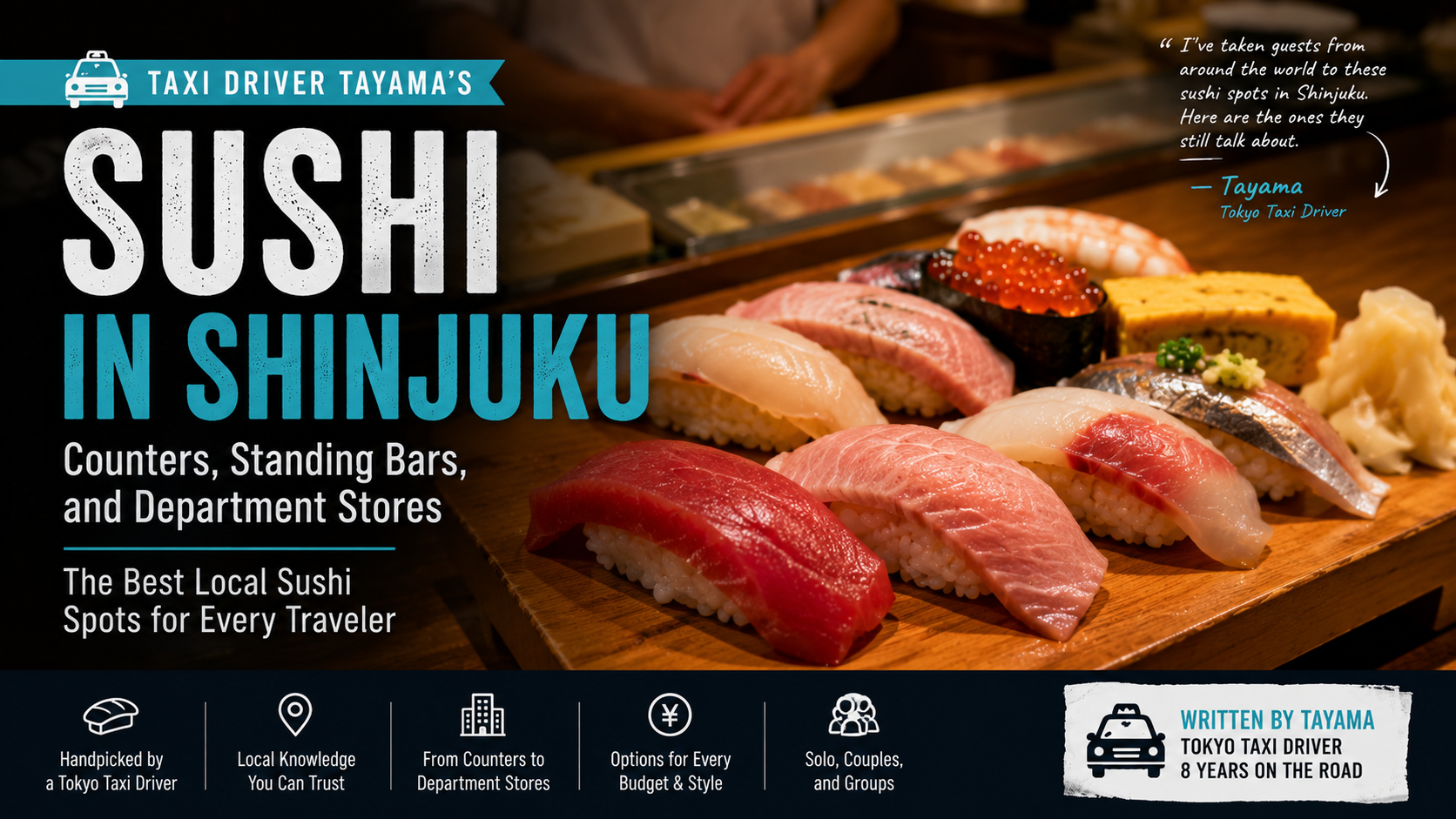
Most people who visit Shinjuku for the first time think of ramen, yakitori, and izakaya. That’s fair — Shinjuku does all three exceptionally well. But the neighbourhood’s sushi scene is equally strong, and it’s far more varied than most guides suggest. I’ve been dropping passengers at sushi counters, standing bars, and department store food halls across Shinjuku for eight years. This is what I know.
Shinjuku sushi covers every format. There are intimate counter restaurants where a chef places one piece at a time in front of you and explains each cut. There are standing bars where you eat a perfect tuna nigiri in four minutes for ¥300 and carry on with your day. There are department store basement floors with sushi counter restaurants that serve Edomae-trained chefs alongside display cases of impeccable takeout sushi. And there are all-you-can-eat sushi operations that, contrary to what you might expect, maintain genuinely good quality.
The question isn’t “is there good sushi in Shinjuku?” The question is: what kind of sushi experience do you want tonight? This guide answers that.
🚖 About This Guide
Written by Tayama, Tokyo taxi driver with 8 years on the road. Restaurants selected based on passenger recommendations, personal visits, Tabelog ratings, and cross-referencing Google Maps and local knowledge. No sponsored content. Prices and hours current as of June 2026 — always verify directly before visiting.
Why Shinjuku Is a Great Area for Sushi
Shinjuku’s sushi landscape benefits from the same pressure that makes its entire food scene sharp: the customer base won’t tolerate mediocrity. Three and a half million people pass through Shinjuku Station daily. Among them are Tokyo office workers who have been eating sushi seriously their whole lives, visiting food writers, and overseas tourists with increasingly high expectations. A sushi restaurant that can’t hold its own disappears quickly.
The area is also exceptionally convenient. Multiple large department stores — Isetan, Takashimaya, Odakyu, Keio — each maintain excellent depachika (basement food hall) levels with sushi counters and takeout cases staffed by trained chefs. This means even a traveler with no time to sit down can access excellent sushi by walking into a building they’re passing anyway.
¥200
Standing bar nigiri from
(per piece)
5+
Major department store
food halls within 10 min
8 AM
Earliest standing sushi
opens inside Shinjuku Station
From a taxi driver’s perspective, the sushi geography breaks into four zones. West Exit (Nishi-Shinjuku) for standing bars and mid-range counter restaurants. East Exit / Shinjuku-sanchome for counter restaurants, omakase, and the department stores. Inside Shinjuku Station for the rare but excellent built-in standing bar at Lumine. And Takashimaya / New South Gate area for department store dining and the walk toward Yoyogi.
How to Choose the Right Sushi Experience
Japanese sushi comes in several distinct formats, each with different etiquette, price points, and appropriate occasions. Understanding which format suits you is the most useful thing you can do before picking a restaurant.
🍣
Counter (Omakase)
Sit at a wooden counter while the chef places pieces directly in front of you. Eat immediately — sushi is made to be eaten in one or two bites, right after it’s placed. The format ranges from ¥8,000 lunch to ¥30,000+ dinner.
→ Best for: special occasions, solo diners who want full focus
🧍
Standing Bar (Tachizushi)
Stand at a counter, order individually by pointing or using a sheet. Pieces run ¥150–¥400 each. Quick, social, entirely legitimate — this is how many Tokyo workers eat sushi on a Tuesday.
→ Best for: quick meals, solo travelers, budget
🏬
Department Store Sushi
Two formats: sit-down counter restaurants on upper floors, and takeout sushi from the depachika basement. Depachika sushi is exceptional quality in a no-pressure environment.
→ Best for: families, rainy days, no reservation needed
🔄
Conveyor Belt (Kaiten-zushi)
Choose plates from a moving belt or order via tablet. English ordering common. Family-friendly, low-pressure, broad menu range. Quality varies — the best chains rival sit-down places.
→ Best for: families, first-timers, groups
🍱
Casual A La Carte
Sit-down restaurant, order from a menu at your own pace. Mix of nigiri sets, sashimi, and cooked dishes. Less formal than omakase. Good for groups with mixed appetites.
→ Best for: groups, relaxed dinner, families
🍽️
All-You-Can-Eat (Sushi Tabehoudai)
Flat fee, time limit (typically 90–120 min), order freely. Quality in Shinjuku is higher than the format’s reputation suggests. Look for chains sourcing from Tsukiji or Toyosu daily.
→ Best for: value seekers, groups, kids
Know Your Neta: Essential Sushi Toppings Explained
Neta (ネタ) is the topping placed on the rice. Knowing the classics helps you order with confidence and appreciate what the chef is doing. Here’s a quick reference for what you’ll encounter most often at Shinjuku sushi counters.
Common Sushi Neta & What to Know
| Japanese | English | Flavour | When to Order |
|---|---|---|---|
| マグロ (Maguro) | Bluefin tuna (lean) | Clean, iron-rich, mild. The benchmark. | First piece to calibrate quality |
| 中トロ (Chutoro) | Medium-fatty tuna | Rich, buttery. Balance of fat and red. | Best value tuna upgrade |
| 大トロ (Otoro) | Fatty tuna belly | Melts immediately. Intensely fatty. | Once per visit, if budget allows |
| サーモン (Saamon) | Salmon | Sweet, fatty, familiar. Gateway piece. | Good starting point for first-timers |
| ヒラメ (Hirame) | Flounder | Delicate, clean, slightly sweet. | Order at quality counters (seasonal) |
| ウニ (Uni) | Sea urchin | Intensely briny, creamy, oceanic. | Polarising — taste first, then decide |
| イクラ (Ikura) | Salmon roe | Salty pop, bursts on tongue. | Usually gunkan (boat-shaped) form |
| エビ (Ebi) | Cooked shrimp | Sweet, familiar. Often a children’s favourite. | Safe choice for less adventurous diners |
| タコ (Tako) | Octopus | Firm, slightly chewy, clean flavour. | Standard at most places |
| 玉子 (Tamago) | Sweet egg omelette | Sweet, soft, no fish. A chef’s skill test. | Often ordered last as a palate conclusion |
🚖 Tayama’s Ordering Arc
At a counter, I always start with maguro — it tells you immediately how serious the kitchen is. Then hirame if it’s seasonal, then chutoro, then something from the sea (uni or ikura if I’m in the mood), then finish with tamago. The egg omelette at the end isn’t an afterthought — at a serious Edomae counter, it’s how the chef shows you their technique with something non-fish. If the tamago is good, everything was good.
Best Sushi Counters in Shinjuku
A proper sushi counter is an entirely different experience from any other format. You’re seated directly in front of the chef, who places each piece one at a time. Eat immediately — sushi is made at body temperature, designed to be eaten within seconds of placement. The counters below range from accessible mid-range to full omakase. All require advance booking.
Sushi Miyagawa Shinjuku
鮨 みや川 新宿 — 3-20-5 Shinjuku, 6F-A
A five-star hotel-trained sushi chef runs this quietly respected counter near Shinjuku-sanchome station. The concept is counter-style seasonal omakase: a cours of nigiri and small dishes that rotates with what arrived that morning from the market. The chef visits suppliers himself daily — an increasingly rare commitment at this price point.
The sake and shochu selection is curated specifically to pair with the fish, not just accompany it. A skilled sommelier-style selection process means the drink doesn’t compete with the neta. Private rooms available for groups who want a more enclosed setting.
- Best For
- Counter experience, sake lovers, couples, business meals
- Signature
- Daily omakase nigiri course, sea urchin assortment, seasonal izakaya dishes
- English
- Limited but staff patient; photo menu for reference
- Nearest Station
- Shinjuku-sanchome — 2 min · Shinjuku Station — 2 min walk
- Hours
- Lunch from ¥2,000; Dinner ¥6,000–¥10,000
- Reservation
- Essential — Tabelog or Retty; book 3–5 days ahead
🚖 Taxi Driver’s Tip
The building entrance isn’t obvious from the street — it’s a narrow door in a mid-rise building. Tell a taxi “Shinjuku san-chome, san-niju-go ban” and show the address on your phone. The lunch set here is one of Shinjuku’s best-kept sushi secrets: ¥2,000 for proper Edomae nigiri in a quiet setting. Go at 11:45 AM before the office crowd arrives.
Shinjuku Sushi Aomi
新宿 鮨 青海 — 7-9-13 Nishi-Shinjuku, 4F
The owner-chef here has been doing Edomae sushi exclusively for over thirty years. He sources daily, personally. The restaurant’s reputation for sea urchin is unusually specific: the kitchen assembles uni from multiple prefectures simultaneously and serves them together as a tasting — something that requires a supply chain most restaurants can’t maintain.
The counter is 7 meters of clean straight cedar. No decorative clutter. The focus is entirely on the fish. The “small portions of many things” philosophy means the omakase course covers more variety than most competitors at the same price point — good for people who want to range widely rather than receive fewer, more theatrical pieces.
- Best For
- Experienced sushi eaters, uni enthusiasts, quiet dinner
- Signature
- Multi-prefecture uni flight, seasonal rare fish, women’s portion option
- English
- Limited; reservation staff can assist
- Nearest Station
- Nishi-Shinjuku (Oedo) — 2 min · Seibu Shinjuku — 3 min
- Hours
- Dinner from 17:00; confirm current hours
- Reservation
- Required — Retty, Tabelog, or phone
🚖 Taxi Driver’s Tip
Nishi-Shinjuku’s side streets are calm even when Kabukicho is packed — this is a genuine neighbourhood restaurant despite the proximity. Drop-off from a taxi: “Nishi-Shinjuku nana-chome, Ishikawa Building.” The 4th floor location means no street noise during the meal. A good choice if you want a proper sushi dinner without feeling like you’re in tourist territory.
Sushi Kosuke — Nishi-Shinjuku
鮨 こう介 — 1-15-8 Nishi-Shinjuku, B1F
This is not traditional Edomae sushi. The chef trained at Ginza Michelin-starred restaurants and opened in Nishi-Shinjuku in 2022 with a deliberate departure from convention: the approach here prioritises concentrated umami above all else, using techniques (layered acid vinegars, precisely timed resting of fish, 50-knife otoro preparation) that treat sushi as a vehicle for the most intense version of each ingredient’s flavour.
The result has been polarising — traditionalists sometimes find it too interventionist, while diners seeking a new kind of sushi experience rank it among the most memorable meals they’ve had in Japan. The basement setting in a quiet building seconds from Shinjuku Station creates an unexpectedly private atmosphere for the neighbourhood.
- Best For
- Special occasions, those seeking non-traditional sushi, food-focused travelers
- Signature
- Innovative otoro preparation, amadai (tilefish) scale-fry, hamaguri dashi
- English
- Moderate — counter format allows for pointing and gesturing
- Nearest Station
- Shinjuku Station (Marunouchi Line Exit 7) — 1 min
- Hours
- Dinner only; confirm via reservation
- Reservation
- Essential — OZmall or phone; book 2+ weeks ahead
🚖 Taxi Driver’s Tip
The address is right next to Shinjuku Station’s Marunouchi Exit 7 — any taxi will find it instantly. The basement entrance is subtle; look for the small wooden sign. This is a restaurant where I’d suggest arriving five minutes early, not late — the chef’s timing for the first courses is deliberate. Budget for the experience, not the meal: you’re paying for technique as much as fish.
Best Standing Sushi Bars in Shinjuku
Tachizushi (立ち寿司) — standing sushi — is one of the most Tokyo things you can do. You order pieces one or two at a time, eat them immediately at the counter, pay as you go. It’s not a lesser version of counter sushi: it’s a completely different ritual, optimised for speed and focus on the fish itself. Prices run ¥150–¥500 per piece. No reservation, no dress code, no wait.
Uogashi Nihon-ichi — West Exit Branch
魚がし日本一 新宿西口店
The standing sushi bar Shinjuku regulars return to most consistently. Three or four minutes walk from Shinjuku Station’s west exit, tucked into one of the side streets behind Yodobashi Camera. Two or three chefs rotate, meaning service stays fast even when it’s packed — and it is often packed.
The English menu removes the usual language anxiety: point, nod, receive. The fish quality is significantly higher than the price implies — Uogashi Nihon-ichi has been doing this long enough to have a supply chain that chains can’t match at comparable prices. The tuna is genuinely good. The seared flounder, if it’s on the day’s menu, is exceptional.
A full meal here — six to eight pieces plus miso soup — runs ¥1,200–¥2,500 depending on what you order. You can eat in under 20 minutes. Most people eat in under 20 minutes.
- Best For
- Quick quality sushi, solo travelers, the authentic tachizushi experience
- Signature
- Tuna (all grades), fresh daily catches, seared flounder when available
- English
- Good — English menu available, pointing works perfectly
- Nearest Station
- Shinjuku West Exit — 3–4 min walk (behind Yodobashi Camera)
- Hours
- Generally 11:00 until late; confirm on Tabelog
- Reservation
- Walk-in only — queue moves fast
🚖 Taxi Driver’s Tip
Taxi access: the streets around here are narrow — best drop-off is Shinjuku Station West Exit then walk 3 minutes. When I have 30 minutes between runs, this is where I go. That’s not a romantic endorsement: it’s a practical one. The fish is good, the turnover is fast, and nobody looks at you strangely for leaving after five pieces. Peak hours: 12–1 PM and 7–9 PM. Come outside those windows.
Tachi Zushi Sushiyoko — Inside Shinjuku Station
立ち寿司 寿司横丁 — EATO Lumine, JR Shinjuku gates
Located inside the JR Shinjuku Station gates at the EATO Lumine food complex, Sushiyoko opens at 8:00 AM daily — which makes breakfast sushi entirely possible, and genuinely enjoyable. The in-gates location means you don’t need to exit the station to access it, which matters if you’re transferring between trains.
The ordering system uses a bilingual sheet (English and Japanese): circle what you want, indicate wasabi preference, hand to the chef. No language anxiety. Grab-and-go box sets are available for passengers with a platform to get to. The fish quality is solid for this format — not Ginza-level, but significantly better than airport sushi, and served fresh by a chef who is actually cutting and assembling in front of you.
- Best For
- Breakfast sushi, transit travelers, quick station bites
- English
- Excellent — bilingual order sheet, grab-and-go options
- Location
- Inside JR Shinjuku gates, EATO Lumine — no station exit required
- Hours
- 08:00 – 23:00 daily
- Address
- 3 Chome-38-2 Shinjuku (Lumine building, inside gates)
- Reservation
- Walk-in only
🚖 Taxi Driver’s Tip
I mention this one specifically to travelers catching early trains or arriving into Shinjuku and wanting something real before a long day. 8 AM fresh-cut sushi at a station is not common anywhere in the world. The box sets are excellent for taking onto the Shinkansen — much better than anything in the station convenience stores.
Tachi Zushi Yokochou — West Exit
立ち寿司 横丁 新宿西口 — 3 min from West Exit
This is the budget end of Shinjuku tachizushi, and it earns its place on this list not despite the price but because of what the price makes possible. Fish sourced daily from Tsukiji at ¥75 per piece means even on a tight travel budget you can eat sushi made by a trained chef, using market-fresh fish, for less than a convenience store onigiri.
The atmosphere is entirely functional — standing, fast, local workers at lunch. Tabelog reviews from 2025–2026 from regulars describe it as a reliable lunch stop precisely because it doesn’t try to be anything other than fast, fresh, cheap sushi. That’s not faint praise in Shinjuku.
- Best For
- Budget travelers, quick lunch, volume eating
- English
- Photo menu; pointing works fine
- Nearest Station
- Shinjuku West Exit — 3 min walk
- Hours
- Lunch and dinner; confirm current hours
- Reservation
- Walk-in only
- Note
- Cash preferred; very fast turnover
🚖 Taxi Driver’s Tip
The context here is: you’re not coming for an experience, you’re coming for the fish. Know what you want before you get to the counter — the pace is fast and lingering while deciding is mildly antisocial. Best order: tuna in whatever grade is available that day, salmon, and one thing you can’t identify. The unknown piece is usually the best value.
Best Department Store Sushi Options
The depachika (デパ地下, department store basement food hall) is one of Japan’s genuinely great institutions. Shinjuku has several world-class examples. Each follows the same model: trained artisan vendors operating branded counters, producing the same quality food they’d serve in a full restaurant, at accessible prices, with no reservation and no pressure. For sushi, the depachika model works exceptionally well.
Isetan Shinjuku — Basement Food Hall (B1/B2)
伊勢丹 新宿店 地下1・2階 — 3-14-1 Shinjuku
Isetan’s basement food hall is consistently described as the finest depachika in Tokyo — a distinction it earns through vendor curation rather than size. The sushi options on B2 include multiple established brands, with takeout nigiri sets prepared fresh throughout the day. The fish quality reflects Isetan’s sourcing standards rather than a restaurant’s individual relationships — meaning it’s consistently good across the entire floor.
The practical advantages for travelers are significant: directly connected to Shinjuku Station (Shinjuku-sanchome Exit B5), no weather issues, open until 8 PM, no language barrier for takeout (you point at what you want and it’s boxed for you), and tax-free shopping is available for tourists on qualifying purchases.
For a proper sit-down sushi meal, the sit-down restaurant floors (7F, 8F) include several serious counter operations accessed via escalator from the main building.
- Best For
- Takeout sushi, rainy days, no reservation, families, food souvenir shopping
- Format
- Takeout display cases + sit-down options on upper floors
- English
- Good — pointing works, some staff speak English, tax-free counter
- Nearest Station
- Shinjuku-sanchome Exit B5 — direct underground connection
- Hours
- 10:00 – 20:00 daily
- Pro Tip
- Visit at 6–7 PM: some counters discount prepared foods 20–30% before close
🚖 Taxi Driver’s Tip
The best taxi drop-off for Isetan is the Shinjuku-dori entrance (east side of the building) — tell the driver “Isetan Shinjuku, Shinjuku-dori iriguchi.” The 6 PM discount window is real and reliable — I’ve taken this tip from passengers who use Isetan’s basement as a weekly dinner routine. A ¥2,000 discount on premium sashimi sets is not uncommon.
Tsukiji Tamasushi — Takashimaya Times Square 13F
築地玉寿司 新宿高島屋店 — 5-24-2 Sendagaya, 13F
Tsukiji Tamasushi is an established Tokyo sushi chain with a serious reputation for sourcing quality. The Takashimaya Times Square branch occupies a full sit-down counter on the 13th floor, directly connected to Shinjuku Station’s New South Exit — no weather issues, easy to find, impossible to get lost reaching it.
The menu covers everything from single pieces at ¥165 to assorted sets and sashimi courses. The “40+ varieties of nigiri and maki” menu scope means anyone in a group can find something they want. Kids’ chairs available. The interior mural by an international artist creates a warm, non-intimidating atmosphere suited to families and first-timers.
- Best For
- Families, first-timers, groups with mixed appetites, rainy days
- Signature
- Honmaguro sets, 40+ nigiri types, children’s menu
- English
- Good — photo menu, experienced international staff
- Nearest Station
- Shinjuku New South Exit — 2 min (direct building connection)
- Hours
- Lunch and dinner; check Takashimaya restaurant floor hours
- Reservation
- Walk-in or Tabelog; weekend lunch gets busy
🚖 Taxi Driver’s Tip
Takashimaya is the easiest department store in Shinjuku to reach by taxi: “Takashimaya Times Square Shinjuku, minami-guchi iriguchi.” The building is immediately next to the South Exit of Shinjuku Station. For families with young children, this is my honest first recommendation — accessible, kid-friendly, no language anxiety, and decent sushi all at once.
Best Budget Sushi for Travelers
Budget sushi in Shinjuku means under ¥3,000 for a full meal. This is entirely achievable without compromising on freshness or quality — you’re trading environment and format (standing vs seated, chain vs independent) rather than fish quality.
Tsukiji Kaisensushi Sushimamire — Godzilla Road
築地海鮮寿司 すしまみれ 新宿セントラルロード店
On the main Kabukicho boulevard — the street locals call Central Road and tourists call Godzilla Road — Sushimamire has been running as a budget Edomae counter for years while the restaurants around it cycle through trend cycles. The kitchen sources from Tsukiji daily. The chef is properly trained. The prices shouldn’t be as low as they are for the fish quality.
The specialist set — the “Mejiki Pro Manager’s Selection” — combines otoro, chutoro, akami, botan shrimp, and uni in a single plate. Under ¥3,000, including miso soup. It’s the benchmark dish: order it once to understand what the kitchen can do, then fill in around it with single pieces of whatever looks good that day.
- Best For
- Value-seeking travelers, solo dining, Kabukicho location
- Signature
- Mejiki Pro Manager set, honmaguro, red clam (akagai)
- English
- Good — photo menu, central road location used to tourists
- Nearest Station
- Shinjuku East Exit — 3 min walk
- Hours
- Opens early; confirm current hours
- Reservation
- Walk-in; can get busy evenings
🚖 Taxi Driver’s Tip
I drop passengers at the Kabukicho entrance regularly, and Sushimamire is one of the places I mention when someone asks “what’s actually worth eating near Godzilla Road?” It’s not hidden — it’s on the main strip — but it survives on locals as well as tourists because the quality justifies return visits. If you’re spending the evening in Kabukicho, this is the right pre-drinks sushi stop.
Kizunasushi — Kabukicho (AYCE)
きづなすし 新宿歌舞伎町店 — 1-18-8 Kabukicho, B1/1F
Kizunasushi occupies a specific niche: serious sushi sourcing (direct from Tateyama fishing port in Chiba — fish swimming that morning) combined with an all-you-can-eat format at prices that make it accessible for families and groups. The 80-plus sushi varieties and 20 cooked dishes create a menu broad enough for very mixed groups.
The format has appeared across multiple TV programmes, primarily because the combination of AYCE and genuine quality sourcing is unusual. The three-tier roll sushi, the set pieces, and the sashimi options outside the unlimited course are all worth exploring even if you’re not going for the tabehoudai. Baby stroller access confirmed.
- Best For
- Families, mixed groups, AYCE first-timers, large parties
- Nearest Station
- Seibu Shinjuku — 2 min walk · Shinjuku East — 6 min
- English
- Good — menu photos, experienced tourist-facing staff
- Hours
- Lunch and dinner; confirm tabehoudai time slots
- Reservation
- Hotpepper or walk-in; groups should book ahead
- Note
- Drinks package available separately; kids’ menu included
🚖 Taxi Driver’s Tip
Best taxi drop-off: Seibu Shinjuku Station front exit — the restaurant is literally two minutes on foot. For family trips where at least one person is sushi-uncertain, the AYCE format removes budget anxiety from the equation. Everyone can eat what they want, order freely, and the fish quality means nobody is compromising. Good choice for first-night Tokyo dinners when everyone is still adjusting.
Best Premium Sushi and Omakase
Omakase (おまかせ) means “I leave it to you” — a set course determined entirely by the chef based on what’s best that day. It requires trust, advance booking, and a budget of ¥15,000–¥30,000 per person for dinner. The experience in return is one of the most concentrated culinary experiences Japan offers. The two counters below represent Shinjuku’s upper tier.
Shinjuku Sushi Yokota
新宿 鮨 よこ田 — 3-20-6 Shinjuku, FS Building B1F
The owner of this restaurant earned a Michelin star eight consecutive years at their Azabu-juban tempura restaurant before opening this sushi-focused Shinjuku offshoot. The combination of sushi and tempura in a course format is the signature here — two techniques treated with equal seriousness, alternating throughout the meal. The tempura uses its own dedicated oil system; the sushi uses seasonal fish selected that morning.
The private room option makes this one of the most practical premium sushi choices for business entertaining or celebrations where a fully enclosed space matters. The lunch course at around ¥5,000 is one of the best value access points to this quality level in Shinjuku.
- Best For
- Business dinners, celebrations, Michelin-pedigree seekers
- Signature
- Sushi + tempura kaiseki course, private room dining
- English
- Good — reservation staff assist, English course menu
- Nearest Station
- Shinjuku Station — 2 min · Shinjuku-sanchome — 2 min
- Hours
- Lunch ¥5,000; Dinner ¥10,000–¥15,000
- Reservation
- Essential — Retty or phone; 1 week+ ahead for dinner
🚖 Taxi Driver’s Tip
The basement location in the FS Building near Shinjuku-sanchome is easy to reach by taxi — show the address on your phone. The private room format makes this the right call for a business dinner where you need to maintain proper conversation without being heard at adjacent counters. The tempura-sushi course combination is also more interesting than straight sushi for guests who might not be 100% sushi-focused.
Shinjuku Makoto — Nishi-Shinjuku
新宿 誠 — 6-2-3 Nishi-Shinjuku, Island Annex 103
The team here trained at five-star hotels and Roppongi/Ginza fine dining before opening this counter in Nishi-Shinjuku. The Edomae approach is traditional but the hospitality style is explicitly welcoming — the restaurant actively seeks international guests and has developed course formats designed to explain each piece as it’s placed.
At ¥6,600–¥11,000 for a full dinner course, this sits in the accessible premium tier — not entry-level, but significantly below the ¥20,000+ that the most prestigious Shinjuku counters command. The Western Shinjuku location means a different calibre of quietness compared to the sanchome area; you’re eating in a corporate neighbourhood, not an entertainment district.
- Best For
- International guests wanting a premium experience, accessible omakase
- English
- Good — English-friendly service is a stated priority
- Nearest Station
- Nishi-Shinjuku (Marunouchi Line Exit 4) — 3 min
- Hours
- Dinner from 17:00; confirm via OZmall or phone
- Reservation
- OZmall or phone; manageable lead time vs top-tier places
- Price
- ¥6,600–¥11,000 dinner; good value for trained Edomae technique
🚖 Taxi Driver’s Tip
Nishi-Shinjuku Island Annex is a well-known building to any Shinjuku driver — it’s in the heart of the skyscraper district. Tell the taxi “Shinjuku Island Annex, roku-chome.” The calm corporate atmosphere here is a genuine feature for some diners: no Kabukicho energy, no tourist-area noise, just a quiet Nishi-Shinjuku evening with serious sushi.
Best Sushi for Solo Travelers
Japan is genuinely the best country in the world for solo dining, and sushi is one of its most solo-friendly cuisines. Counter seating is designed for individual diners. Standing bars require no companion by definition. The spots below are specifically comfortable for single diners with no Japanese language skills.
Standing Sushi Bar — Nishi-Shinjuku
スタンディングスシバー — 1-16-4 Nishi-Shinjuku, 3F
Despite the name, this restaurant provides actual stool seating at a counter — the “standing” refers to the format’s informality rather than the physical arrangement. It’s explicitly designed for international visitors: the order sheet is English and Japanese, the staff speak enough English to be helpful, and the whole operation is structured to be approachable for someone who has never been to a sushi bar before.
Reviewers consistently describe it as one of the most welcoming sushi experiences in the area for non-Japanese speakers. The fish quality is genuine — Toyosu-sourced, prepared by trained chefs — and the prices reflect the format rather than any quality compromise.
- Best For
- Solo travelers, first sushi counter experience, English speakers
- Signature
- Daily fresh fish; chutoro and uni consistently praised
- English
- Excellent — order sheet, most staff English-capable
- Nearest Station
- Shinjuku Station (various exits) — 5 min walk
- Hours
- Lunch and dinner; confirm current hours
- Reservation
- Walk-in; can queue on weekends
🚖 Taxi Driver’s Tip
The 3rd floor location in a building on Kokusaidori (International Street) is five minutes from the west exit on foot. I recommend this specifically to solo travelers who are nervous about their first sushi counter experience — the English order sheet removes the main anxiety, and the counter format means you can watch the chef make your sushi, which is genuinely interesting as an experience even if you come primarily for the food.
🧍 Solo Sushi in Shinjuku — Quick Reference
- → Ask for カウンター席 (kauntaa seki) — counter seat. All sushi places know this immediately.
- → At standing bars, you need no Japanese at all: point at what you want. The chef will place it in front of you.
- → Eating alone at a counter is not unusual in Japan — it’s the original intended format for many sushi places.
- → The phrase おまかせでお願いします (omakase de onegaishimasu) — “please do as you see fit” — is a complete solo counter order.
Best Sushi for Families and First-Time Visitors
The two formats that work best for families and first-timers are conveyor belt (kaiten-zushi) and the casual AYCE operations. Both allow everyone to eat at their own pace, try things without commitment, and reorder freely. The Takashimaya option above also works well for families.
Mawashizushi Katsu Midori — Shinjuku
回し寿司 活 美登利 新宿店
Katsu Midori is the kaiten-zushi standard that experienced Tokyo diners actually recommend. The distinction from chain conveyor belt sushi: fish is sourced from Tsukiji daily, the menu changes seasonally, and the iPad ordering system in English means you’re not limited to whatever happens to be passing on the belt.
The operational reality of the Shinjuku branch comes with a caveat: it can have queues, particularly on weekends and during peak dinner hours. The recommendation from experienced diners is to come on a weekday or during off-peak hours (before 12 PM or after 2 PM for lunch; before 6 PM or after 9 PM for dinner). Once seated, the experience is straightforward and reliably satisfying.
- Best For
- Families, first-time conveyor belt experience, groups, budget-conscious
- English
- Excellent — full English iPad ordering
- Price Range
- ¥100–¥500 per plate; full meal ¥1,500–¥3,000
- Nearest Station
- Shinjuku area — confirm specific branch address
- Hours
- 11:00–23:00; confirm
- Queue Note
- Weekday off-peak recommended; weekend waits possible
🚖 Taxi Driver’s Tip
Katsu Midori is the sushi place I recommend to families who ask “somewhere the kids will enjoy and the adults won’t feel like they’re eating airport food.” The conveyor belt is engaging for children; the iPad ordering in English removes parental stress; the Tsukiji sourcing means the fish is genuinely fresh. If there’s a queue when you arrive, note the wait time — it usually moves faster than the length suggests.
Sushi Etiquette for Foreign Travelers
Sushi etiquette is often overstated in travel media — the actual rules are fewer than you’ve probably read. Here’s what genuinely matters at a Shinjuku sushi counter, simplified.
⏱️
Eat Immediately
At a counter, the chef places sushi directly in front of you. Eat it within a minute — ideally seconds. The rice is body-temperature warm, the fish is precisely chilled. Waiting until all pieces are placed before eating defeats the purpose.
🤲
Hands or Chopsticks: Both Fine
Eating nigiri with your fingers is completely acceptable — it was the original method. Chopsticks are equally fine. The one thing to avoid: turning the piece upside-down to dip rice-side into soy sauce. Dip the fish-side lightly, or ask the chef to brush soy sauce on for you.
🧂
Soy Sauce — Less Is More
At a quality counter, many pieces are already seasoned (salt, citrus, ponzu brushed on by the chef) and need no additional soy. Ask if you’re not sure — saying “soy sauce?” while hovering over a piece will get a nod or headshake from the chef.
🌿
Wasabi and Ginger
Wasabi is incorporated into most nigiri between the fish and rice. If you don’t want it, say “wasabi nuki” (without wasabi). The pink pickled ginger is a palate cleanser — eat between pieces, not on top of a piece. Don’t mix it into the soy sauce.
💬
Talking to the Chef
At a proper counter, brief conversation with the chef is normal and often enjoyable. They may explain what each piece is, how it was prepared, and where the fish came from. Don’t use your phone loudly. Do ask questions about the fish — most chefs respond positively to genuine curiosity.
💴
Paying
At a counter omakase, payment is usually at the end: say “o-kaikei onegaishimasu.” At standing bars, you often pay per piece as you go. No tipping, ever. Cash is preferred at many smaller counters; check when booking.
Useful Japanese Phrases for Sushi Restaurants
You need very little Japanese to eat sushi well in Shinjuku. These phrases cover the situations where language helps.
Essential Sushi Phrases
Area Guide: Where to Find Sushi in Shinjuku
Shinjuku’s sushi landscape organises itself by area. Each zone has a different character and suits different types of visits.
🏢 West Exit / Nishi-Shinjuku
Best for: Standing bars, mid-range counter, quiet dinner
- ✦ Uogashi Nihon-ichi (standing bar classic)
- ✦ Sushi Aomi (30-year Edomae specialist)
- ✦ Shinjuku Makoto (accessible premium counter)
- ✦ Tachi Zushi Yokochou (budget ¥75/piece)
JR West Exit → 1–5 min walk
🏘️ East Exit / Shinjuku-sanchome
Best for: Premium counter, omakase, department stores
- ✦ Sushi Miyagawa (hotel-trained chef, sake pairing)
- ✦ Sushi Kosuke (innovative, Ginza-trained)
- ✦ Sushi Yokota (Michelin pedigree, tempura combo)
- ✦ Isetan B2 depachika (best food hall in Tokyo)
- ✦ Standing Sushi Bar (English-first, counter seating)
East Exit or Sanchome Station → 1–5 min walk
🌃 Kabukicho / Godzilla Road
Best for: Budget, AYCE, late-night accessible options
- ✦ Sushimamire (Tsukiji daily, Godzilla Road location)
- ✦ Kizunasushi (AYCE, families, large groups)
- ✦ Itamae Sushi Toho Building (honmaguro focus, 100 seats)
Seibu Shinjuku → 2 min / East Exit → 5–7 min
🏬 Takashimaya / New South Gate
Best for: Families, department store dining, rainy days
- ✦ Tsukiji Tamasushi (13F, ¥165/piece, kids menu)
- ✦ NEWoMan food floor (curated quality options)
- ✦ Takashimaya depachika (B1/B2 takeout sushi)
New South Exit → direct connection
🚂 Inside Shinjuku Station (EATO Lumine)
Best for: Breakfast sushi, transit travelers, zero weather exposure
- ✦ Tachi Zushi Sushiyoko — open from 8 AM, English bilingual order sheet, inside JR gates
- ✦ Grab-and-go box sushi also available from the same counter — perfect for train journeys
Inside JR Shinjuku gates — no exit required
Frequently Asked Questions
What is the difference between omakase sushi and a la carte?
How much does sushi cost in Shinjuku?
Do I need to book a sushi restaurant in advance in Shinjuku?
What is Edomae sushi and how is it different from other styles?
Can I eat sushi in Shinjuku without any Japanese language skills?
What is the best time to eat sushi in Shinjuku to avoid queues?
Is there sushi for vegetarians or people who don’t eat raw fish in Shinjuku?
What should I know about depachika (department store basement food halls)?
How do I ask a sushi chef to go easy on wasabi or salt?
What is the best sushi near Shinjuku Station for a quick meal?
Taxi Driver Tayama’s Final Recommendation
Shinjuku sushi rewards a different instinct than most food guides suggest. The obvious places — the ones on Godzilla Road with English menus posted outside — are fine. But the most satisfying sushi experiences here tend to come from matching the format to what you’re actually doing that day, not picking the highest-rated name on an app.
- If you have one hour and one goal — Go to Uogashi Nihon-ichi, stand at the counter, order tuna in whatever grade they recommend, eat it in under 20 minutes. This is Shinjuku sushi distilled.
- If you want a memory — Book Sushi Miyagawa for lunch (¥2,000 set), sit at the counter, tell the chef omakase, and let 45 minutes happen. The lunch price for counter Edomae sushi at this level is extraordinary.
- If it’s raining — Isetan basement, B2. Walk there underground from Shinjuku-sanchome station. Buy a nigiri set. Eat in the station or take it to your hotel. Outstanding sushi, zero weather exposure.
- If you’re traveling with family — Tsukiji Tamasushi at Takashimaya, 13th floor. Kids welcome, ¥165 per piece, English-friendly. No booking needed for weekday lunch.
- If you want the full experience — Book Sushi Kosuke two weeks ahead for dinner. Budget ¥25,000. It’s not Edomae tradition — it’s something newer and more personal. Worth the planning.
One last thing about sushi that I always tell passengers: don’t pace yourself for the end. The first piece is placed when your palate is fresh and your attention is at its sharpest. That’s when the chef wants you to eat it. The toro you saved for last while filling up on salmon rolls is a toro you won’t fully taste. Eat in sequence, eat immediately, eat deliberately.
The Japanese word is shokunin — craftsperson, artisan. A sushi chef who’s been doing this for thirty years is a shokunin in the same way a carpenter or a calligrapher is. The counter is the best place to be close to that. Use it.
— Tayama | Tokyo Taxi Driver
8 years on the road in Tokyo. Writing at TAKE ME THERE JAPAN and taxi-tenshoku.net. Last updated: June 2026. Prices and hours change — always confirm directly before visiting.
📍 Continue Exploring Shinjuku Food